TRIPS
Editor's PickExperience Taiwan's Vibrant Culture at Moon Festival 2026
Trip Brief
The Mid-Autumn Festival falls on the 15th day of the eighth lunar month, which is 25 September in 2026. In Taiwan, people typically gather with family or friends to barbecue, peel pomelo, eat mooncakes and gaze at the…
Quick Read
Trip Snapshot
- 01
Mid-Autumn Festival 2026 is on 25 September (the 15th day of the eighth lunar month); Taipei, Tainan and Kaohsiung each have a different vibe, so you can choose according to the pace you want.
en.wikipedia.org - 02
The heart of Mid-Autumn is barbecuing, peeling pomelo, eating mooncakes and gazing at the moon; Taiwan's barbecue craze stems from a 1980s ad and is a contemporary, down-to-earth custom rather than an ancient rite.
en.wikipedia.org - 03
Transport goes most smoothly by MRT, and for moon-gazing pick a time slot with clear skies; keep the budget for transport and accommodation, and leave the rest to the atmosphere.
en.wikipedia.org
Charcoal smoke, pomelo and a very bright moon — the night I walked into a Taiwanese Mid-Autumn with my mother, and everything you want to know
When is Mid-Autumn Festival 2026, and how do you remember the date?
Mid-Autumn falls on the 15th day of the eighth lunar month, but the solar-calendar date that the lunar calendar maps to shifts every year, so rather than memorising it, it is easier to remember that it lands on "the night the autumn moon is fullest."
According to the official announcement, the main period in 2026 runs 18 to 20 August, three days in a row, with Taipei as the largest main venue. What I do myself is circle these three days first, then see which evening has the best weather and is easiest to head out.
If the version you see differs from this, please go by the official announcement — the lunar conversion is different every year, which is perfectly normal and nothing to worry about.
Where should you spend Mid-Autumn? How do you choose between Taipei, Tainan and Kaohsiung?
I would recommend all three cities to you, but each has its own flavour.
Taipei is the largest main venue this time, with the most concentrated activities; if you want to be where it is happening, this is the liveliest. Tainan suits those who want to slow down, spending the festival in earnest with friends on this land, with a real sense of human warmth. Kaohsiung has open, spacious air that is comfortable to walk around in, giving you a Mid-Autumn experience quite different from the north.
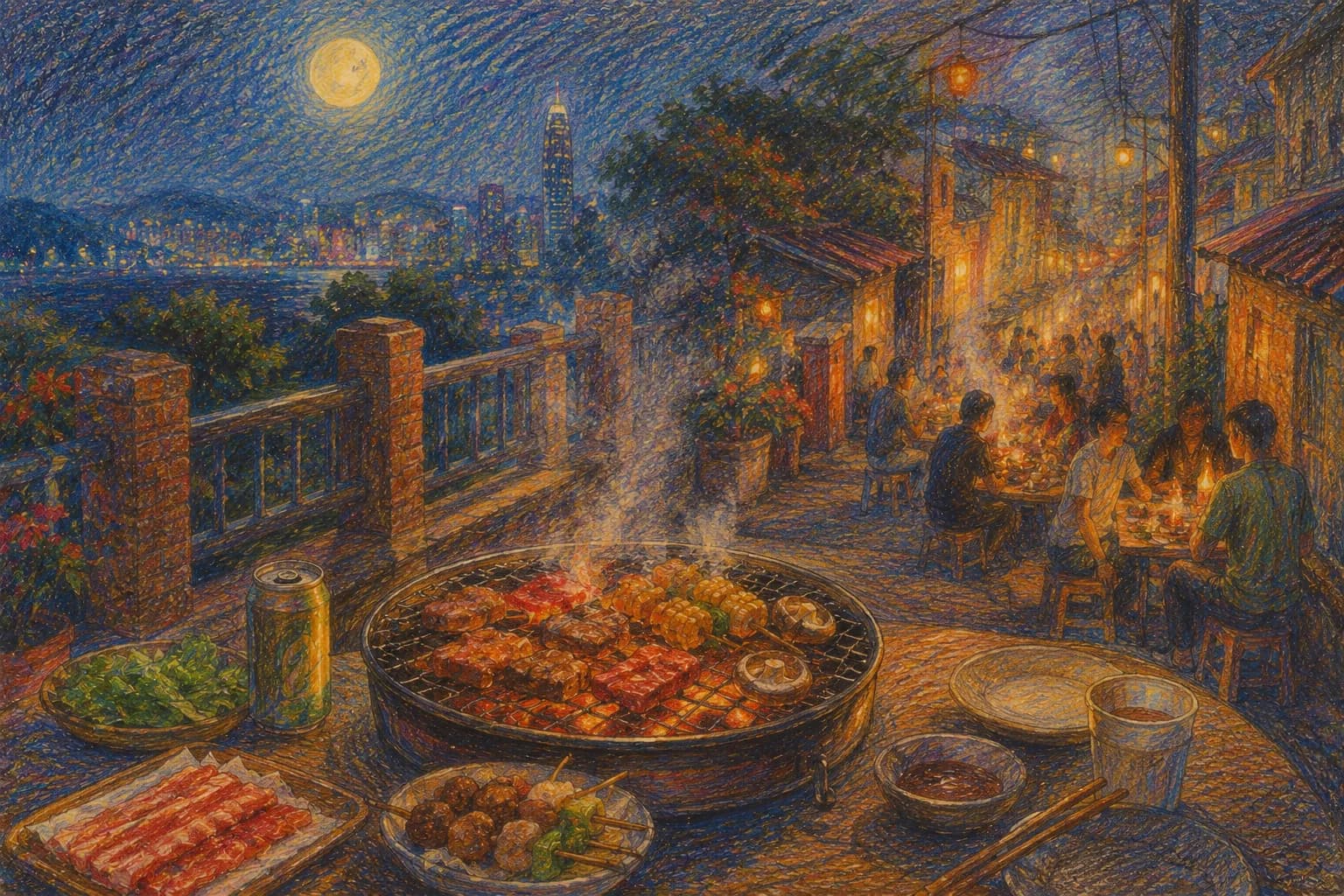
That year I stayed in the alleys of Taipei — the charcoal smell comes first while you are still walking in the lane, and only when you round the corner do you find it is not one household grilling, but the whole street, every family having hauled its grill out under the eaves. That feeling of an entire street coming alive is exactly what you want.
Who is this way of spending Mid-Autumn for? Alone, with elders, or rounding up friends — does it all work?
It all works, and each has its own good points.
That year I was bringing my mother back for Mid-Autumn — she has lived alone these years, and I rarely cleared the time, so I wanted to spend it with her properly. Then someone in the neighbourhood looked up and called "come eat with us"; Mum answered first with a smile, pulling people down to sit, and just like that we settled in among a table of strangers.
So if you are bringing elders, the atmosphere here easily turns the loneliness of two into the warmth of a tableful; if you are rounding up friends, Tainan's "spending the festival together on the land" tone will suit you well; and even if it is just you, finding a spot where you can see the moon and sitting down will not feel lonely either.
How do you arrange transport? Is driving or taking the MRT better?
My advice is simple: take the MRT.
In Taipei you can go straight to the main venue by MRT, sparing yourself the hassle of finding parking; in Kaohsiung you can likewise take the Kaohsiung MRT, or use the buses running back and forth. In Tainan you can consider taking a direct bus, with fewer transfers and less worry.
These few days of Mid-Autumn are crowded, so leaving the car at home and saving your attention for the moon and that table of people will be far more relaxing. For the actual schedules and time slots, remember to set your timing against the festival period table.
Where is it most convenient to stay? Should you pick a spot especially for moon-gazing?
For accommodation, I would follow the "main venue."
Since Taipei is the largest main venue on 18 to 20 August, staying within easy reach of the MRT, so that after the festivities at night you can stroll slowly back, is the smoothest arrangement — that night, as I walked my mother back, the charcoal smell still clung to our clothes and the moon had already risen high; the slow amble home is itself part of Mid-Autumn.
As for whether to seek out a high spot especially for moon-gazing? You really need not be too particular. Many Taiwanese households simply set a table in the yard or under the eaves, eating while glancing up now and then — not formal, but very genuine.
Roughly how much will it cost? Will this trip burn a lot of money?
Honestly, Mid-Autumn spending is very flexible, because the point of this festival is not about spending money.
What you really spend goes mostly on transport (MRT, buses), accommodation (depending on whether you choose Taipei, Tainan or Kaohsiung), and the barbecue and offerings portion. Things like the barbecue and pomelo are often pooled by the whole table, each chipping in a share, so they cost surprisingly little.
The most precious things that night — the liveliness of a table of strangers, the pomelo the grandmother peeled for everyone, the lines at my mother's eyes when she laughed — could not be given a price down to a single cent. Keep the budget to transport and accommodation, and leave the rest to the atmosphere.
Why do people barbecue at Mid-Autumn? Is it really an old tradition?
It is a funny thing: Taiwan's Mid-Autumn barbecue is no ancient tradition at all, but a nationwide craze set off by a barbecue-sauce advertisement in the 1980s, and it never stopped afterwards.
By now this has come to feel more like Mid-Autumn itself than the moon does. Every family hauls its grill out under the eaves, adults turning meat and drinking beer, children chasing among the stalls, fat dripping onto the coals with a hiss and a small spurt of smoke — this is the most typical scene of a Taiwanese Mid-Autumn night today.
It is not a ritual passed down over centuries, yet it is a contemporary custom that truly, genuinely gathers people together. Knowing this, you will better understand why the whole street smells of charcoal.
What is the deal with pomelo at Mid-Autumn? How do you eat it for the best flavour?
Pomelo is a regular guest on the Mid-Autumn table, but the most fun part of it is not just the eating.
At the table that took us in, a grandmother was forever busy peeling pomelo, and when done she casually plopped the white rind onto a nearby child's head as a hat, to the whole table's laughter. That pomelo-rind hat is almost a shared Mid-Autumn memory for Taiwanese children.
The way of eating is very casual: peeling while chatting, eating mooncake and pomelo while watching the moon, with no particular rules. The point has never been to eat it in a refined way, but that the very act of peeling pomelo naturally opens up the whole table's chatter.
What moon-gazing customs are there? How do Taiwanese people "let the moon know"?
The moon is the true lead of the night, only too easily upstaged by the grill.
The Mid-Autumn moon is bright, bright enough that one hardly needs other light. Some Taiwanese households still keep the habit of setting out offerings in the yard, eating mooncake and pomelo while watching the moon — not very formal, just sitting, glancing up now and then, a small way of letting the moon know one is still here.
In that "letting it know" there is a very Taiwanese lightness: not solemn, yet not insincere. If you want to experience the most authentic moon-gazing, you need not seek out any grand occasion — sitting down and looking up is enough.
What should you watch for with crowds and weather? How do you avoid spoiling the mood?
Keep two things in mind first: weather and crowds.
Weather: before setting out, be sure to check whether it will be too rainy that day; heavy rain not only spoils the mood but also easily damages the offerings and food you bring. For moon-gazing you should of course pick a time slot with decent weather — if the clouds are too thick, you will not see that moon.
Crowds: 18 to 20 August is the main period, and Taipei is the largest main venue, so it will be crowded. Take the MRT, avoid the very peak time slots, and keep your itinerary a little loose, and you will suffer less of the crush. Take care of these two points, and you can leave the rest to that night.
Why, after all, is Mid-Autumn worth making a special trip for?
Because it takes a very, very old story and lives it out in today's form.
The moon's story is far older: Chang'e flying to the moon, the jade rabbit pounding medicine in the lunar palace — legends of reunion and longing that the Chinese have told for thousands of years. Such an ancient festival, in today's Taiwan, has become a street full of charcoal and beer — it has not grown shallower, only found another way to gather people back together.
Nothing special happened that night, only everything was just right: the just-right cool, the just-right brightness, a whole table of strangers who kept us company so that a Mid-Autumn that might have been just the two of us turned lively and warm. That moon will be seen again every year, but this one, with someone beside you, will be the one you especially remember — and that is the reason Mid-Autumn is worth making a special trip for.
The whole street is grilling, and you sit down too
The charcoal smell comes first, still in the alley. Round the corner, it is not one household but the whole street — every family has hauled its grill out under the eaves, neighbours dropping in on neighbours, adults turning meat and drinking beer, children chasing among the stalls, fat dripping onto the coals with a hiss and a small spurt of smoke. That year was a Mid-Autumn brought home with my mother — she has lived alone these years, and I had rarely cleared the time to spend it with her properly. Someone in the neighbourhood looked up and called "come eat with us"; Mum answered first with a smile, pulling us down to sit, and just like that, into a Taiwanese Mid-Autumn night.
Executive Summary
Festival Date
25 September 2026 (the 15th day of the eighth lunar month)
Choosing a City
Taipei has the most concentrated activities, Tainan suits a slow-paced celebration, and Kaohsiung has open, comfortable air
Transport Tips
In Taipei and Kaohsiung you can take the MRT; in Tainan consider a direct bus, sparing yourself the hassle of finding parking
Signature Customs
Barbecuing, peeling pomelo, eating mooncakes, and setting a table in the yard or under the eaves to gaze at the moon
Origin of the Barbecue
Taiwan's Mid-Autumn barbecue stems from a nationwide craze set off by a barbecue-sauce ad in the 1980s, and is not an ancient tradition
Weather Reminder
Check whether the day will be rainy before setting out; for moon-gazing, pick a time slot with clear skies and not-too-thick clouds
Trip Brief
City Routes
- Visit Taipei City Hall for its stunning moon-gazing area, accompanied by free popcorn and cultural activities.
- Stroll along the iconic Ximending night market, offering a diverse range of local street food and shopping experiences.
- Explore the National Palace Museum after sunset for a unique lunar-themed guided tour.
- Marvel at the Tainan City Hall's sprawling moon-festival decorations, with interactive art installations and food stalls.
- Experience the Anping Fort's evening music and lantern festival, offering a mesmerizing night of live music and performances.
- Shop for Tainan's finest silks and tea at the Anping Old Street, under the twinkling lights of the autumn moon.
- Join the Kaohsiung City Hall's 'Moonlight Concert', enjoying a harmonious blend of cultural performances and live music under the stars.
- Discover the 'Enchanted Garden' in Kaohsiung's Lotus Pond area, featuring enchanting lantern displays, cultural performances, and night markets.
- Explore the Pier-2 Art Center after sunset for an immersive arts experience, with multimedia exhibits and installations themed around the Mid-Autumn Festival.
Rules
Guidelines
Check city notices, transport timing, and opening hours separately instead of relying on one source.
If a plan includes temples or formal ceremonies, follow on-site rules and local notices.
The national holiday window and city-specific extensions can differ, so confirm city timing before final planning.
FAQ
What day is Mid-Autumn Festival 2026?
The Mid-Autumn Festival is the 15th day of the eighth lunar month, which corresponds to 25 September on the solar calendar in 2026. The lunar conversion shifts every year, so it is best to go by the official announcement.
Which city is best for spending Mid-Autumn?
Taipei has the most concentrated and liveliest activities; Tainan suits those who want to slow down and celebrate in earnest with friends; Kaohsiung has open air that is comfortable to walk around in. The three cities each have a different vibe.
How should I arrange transport — drive or take the MRT?
Taking the MRT is recommended. You can reach both Taipei and Kaohsiung by MRT, and in Tainan you can consider a direct bus, which spares you the hassle of finding parking and is easier when it is crowded.
Why do people barbecue at Mid-Autumn — is it an old tradition?
No. Taiwan's Mid-Autumn barbecue stems from a nationwide craze set off by a barbecue-sauce ad in the 1980s, which carried on afterwards and has now become the most typical scene of a Mid-Autumn night.
How do you eat pomelo (yuzu/grapefruit) at Mid-Autumn?
It is eaten very casually — peeling while chatting, eating mooncakes and pomelo while gazing at the moon. The white pomelo rind is often plopped onto a child's head as a hat, a Mid-Autumn memory for many Taiwanese children.
What should I keep in mind for moon-gazing?
Taiwanese people are used to setting a table in the yard or under the eaves, sitting and glancing up now and then — nothing elaborate. Remember to pick a time slot with clear skies and not-too-thick clouds, or you may not be able to see the moon.
Sources
Continue
More trip ideas
Tickets that may fit this trip