Essay
On a December night, sparks and wooden wheels climb the hill together
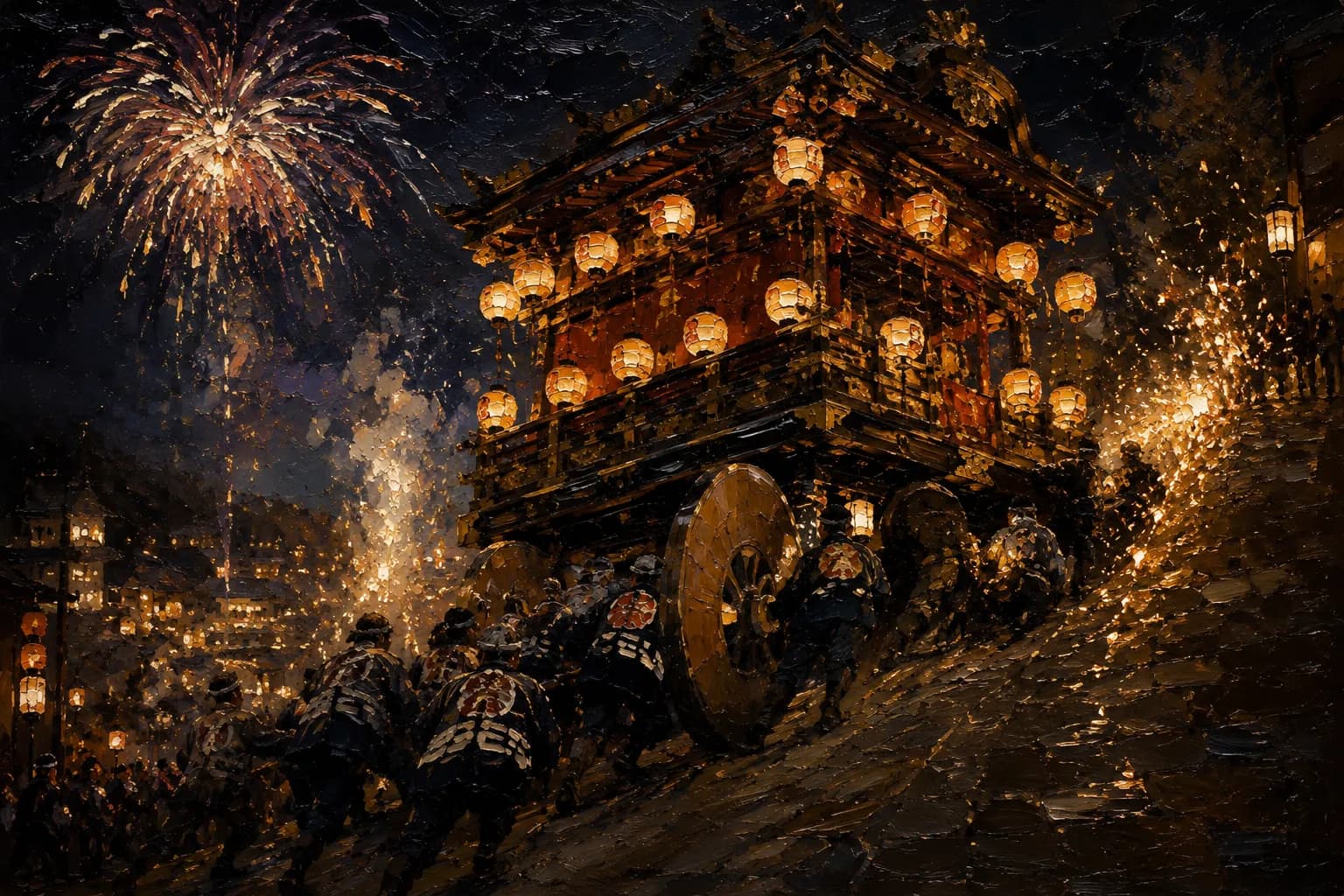
Some festivals do not truly begin until it is cold, and dark. December in Chichibu: a breath goes white at once, hands stiffen in pockets, and even the lashes seem to carry a fine frost. Then flute and taiko reach from far off — a huge float, hauled by dozens, is climbing the steep slope of Dangozaka. The wooden wheels press the thin ice over the flagstones, a sound so low it seems to roll up from underground, and the chest shakes with it, beat by beat.
This is the Chichibu Night Festival, the rite of Chichibu Shrine, held December 2nd and 3rd. Locals say this night is the once-a-year meeting of Myoken, the goddess of Chichibu Shrine, and the dragon god enthroned on Mt. Buko — the float must be hauled all the way to the resting-place where the two gods meet, so however heavy, however steep, up the slope it goes. With Kyoto's Gion and Hida's Takayama it is named one of Japan's three great float festivals, and its hardest test is Dangozaka: a twenty-five-degree slope up which a several-tonne kasaboko must be dragged, by dozens of people, in one freezing burst.
The haulers cry out their rhythm, feet searching again and again for purchase on the frost-slick stone, the wooden wheels inching upward. With every gain the onlookers roar along, and that force of a whole town pulling as one — mixed with the work-cries, mixed with the timber's groan — comes through with strange clarity in the sub-zero air, as if the cold had honed every sound to a finer edge.
The float is hung with lanterns, and the instant it crests the slope the winter sky bursts into fireworks — this is one of the few Japanese festivals to set them off in deep winter. Sparks fall in strings, lighting the white breath of the whole street, and no one speaks. Nearby an old woman wrapped in a thick scarf tilts her head back, fireworks flickering in her eyes, a look she has surely worn for seventy or eighty years and yet still as if for the first time. A few friends who had come only for the fireworks forgot, by the end, to lift their cameras, and only held their breath and shouted low with the crowd.
The fireworks stop, the float is up, the crowd slowly thins, and the amazake stall at the corner still steams, its sweet rice scent carrying far on the cold air. A cup each, fingertips pressed to the warm paper to thaw bit by bit, watching the last few people leave. In the air only a faint smell of gunpowder remains, and the cup's faintly scalding sweetness, not yet finished.
The sweet drink gone, the night deep, the whole town shrinks back into its usual quiet. But the warmth that burst open on the coldest of nights does not scatter so easily. I think you, like us, will one day on some ordinary winter night suddenly think of Chichibu again — and recall that the warmest night of the year falls, of all times, at the coldest, hauled up the slope by a crowd of strangers, together.
Essay