Essay
Hundreds of candles, circling the stupa three times
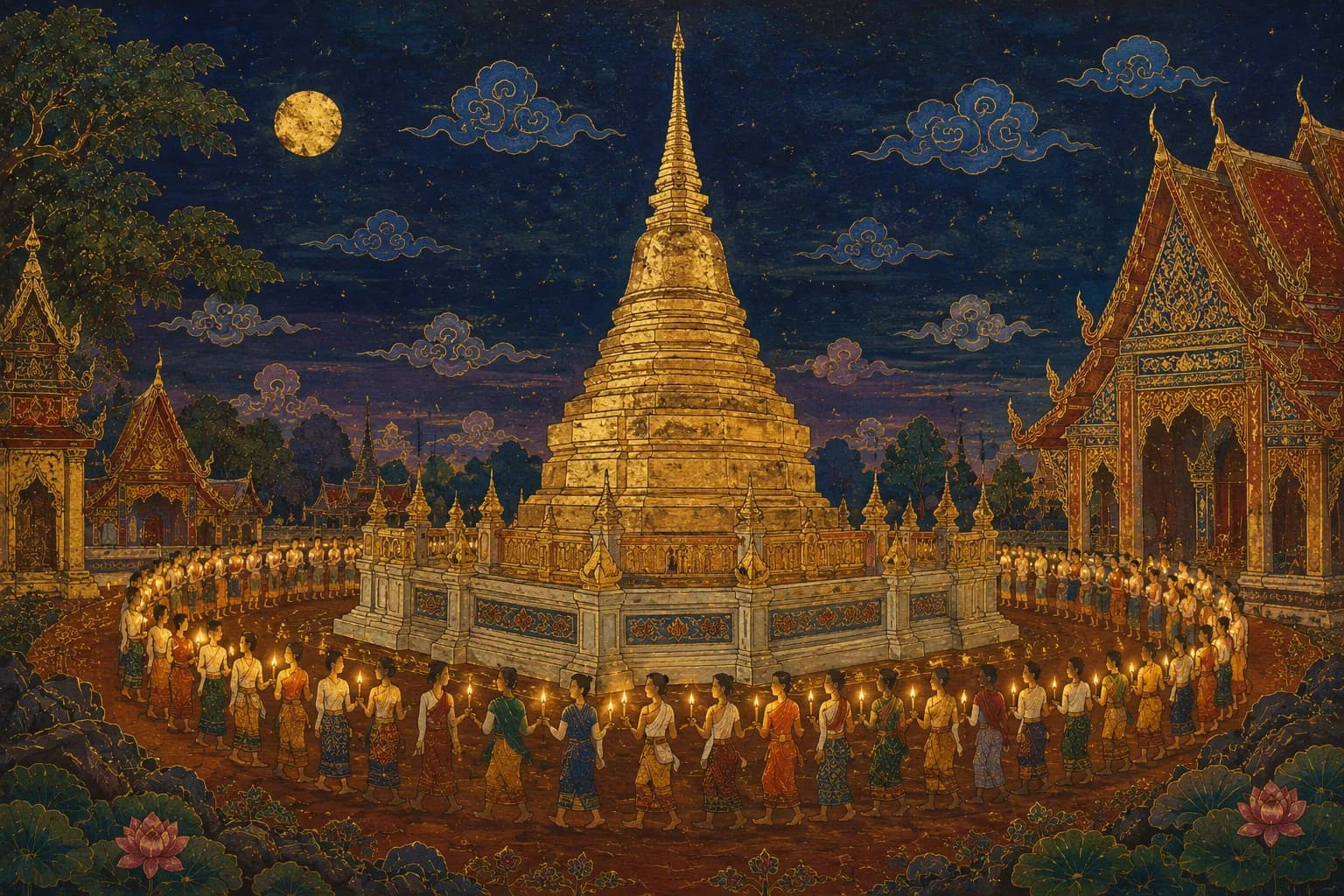
After nightfall, the temple's stupa is ringed by a slowly moving circle of candlelight. The air holds incense and candle wax, warm and quiet. Each person carries a candle, a few sticks of incense and a lotus, walking around the stupa in the same direction. That night was spent accompanying my mother — she has lived alone these years, has believed in the Buddha most of her life, and this night of circling the stupa she would come to no matter what. Taking two candles, one handed to her, one kept, falling into the line, the flames swaying faintly in the night wind.
This is the circling of the stupa at Makha Bucha. Legend holds that on this full-moon night over two thousand years ago, one thousand two hundred and fifty disciples of the Buddha, without prior arrangement, came of one accord before him — and all of them were arahants, already enlightened. On that very night the Buddha taught them the heart of practice: do no evil, do good, purify the mind. Over two thousand years on, the candle in the palm circles that night — a homage that needs no words, remembered through the body.
Ahead, a mother leads a small girl by the hand, steadying the child's little hand so the candle will not tilt and drip; that gesture is easier to understand than any scripture. Further ahead, a young man come alone, eyes closed, lips faintly moving, no telling what he murmurs. The line is long, yet no one speaks, only the sound of hundreds of feet treading softly on the ground, and the candle flames flickering bright and dim in the wind.
On the first circle one still counts the rounds; by the start of the second it is forgotten. Flame, fragrance, footsteps, the cool night wind, slowly cover layer by layer the day's noise stored in the heart. The step slows without noticing — not from tiredness, but from not wanting it to end too soon. This, perhaps, is what the rite truly does: with the time of three circles, it lets one slow down.
The lotus's scent is faint, mixed into the incense, smelled only in deep stillness. Mother walks at my side, her steps much slower than in her younger years, yet the candle in her hand she guards steadily, afraid the wind will put it out. Glancing at her now and then, she is gazing intently at the stupa ahead, her lips faintly moving too — the scripture she has recited most of her life, yet rarely aloud before me.
After three circles, the two of us set the candles in the holder before the stupa, beside hundreds of others, the flames joining into one sheet. Mother stood a long while, eyes closed, palms together. Standing beside her, I suddenly realised it had been a very long time since I simply kept her company through a thing that mattered to her. Those three circles went slowly, slowly enough to recall childhood, when she too led me by the hand around temple after temple — I think if you too accompany someone growing old who holds their faith dear through these three circles, you will likely be like me, loath to see the rounds end too soon.
Essay