Essay
Release a lantern in the valley, and watch it fly over the peak
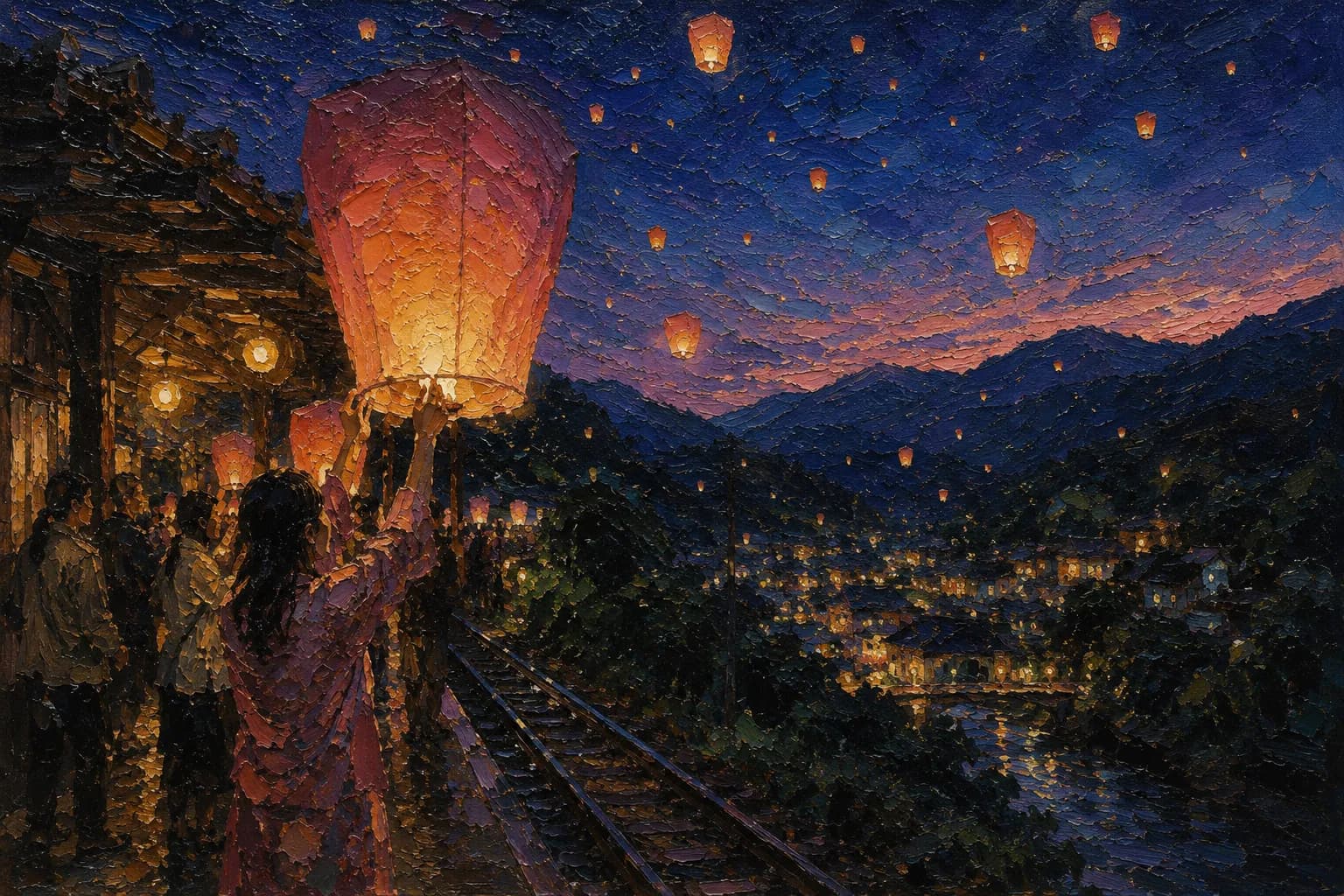
The platform at Pingxi station is small. Off the train, the sky still light, the mountain air a few degrees cooler than Taipei, afloat with the warm smell of rails and greenery baked all day in the sun. The town is narrow, two rows of old houses pressing out a single walkable main street, the railway running right along its edge — every so often a train comes, and the whole street must stop, quietly, to let it pass. At the street's end is the mountain, and behind it more mountain, and standing there is a kind of reassurance, gently ringed by hills.
In a lantern shop a sky lantern is bought and unfolded, four faces of thin white cotton paper. The owner hands over a brush — words may be written. After a moment, a few are written; what they are need not be said. Releasing a sky lantern is not a thing one can do alone — the lantern is large, two people each gripping a bottom corner, waiting for the fuel block in the centre to catch before it slowly swells. So a companion and I held a corner each, watching that flame stretch the thin paper inch by inch into a glowing globe, the weight in the palms growing lighter, bit by bit.
The owner says, "About ready," and the two let go at once. The lantern leaps up, over the eaves of the old houses, over the streetlamps, up into the blue darkening inch by inch above the valley — rising faster than expected, in minutes only an orange point of light, and in another blink even the point is gone, only the mountains left between heaven and earth. The written words, the silent wish, are borne off to a place no longer visible; one still stands in place, hands empty, yet strangely settled within.
Pingxi's lanterns are not only for the Lantern Festival; through the tourist season the shops are open all day, but those Lantern Festival nights are the most spectacular — the authorities release them en masse in the square, hundreds rising at once against the black ridgelines, the whole scene with a texture seen only in films, and here one stands in it for real, not through a screen. The custom's origin is quite practical: in early days bandits often raided the hills, and villagers fled into the mountains; the sky lantern was a signal of safety, telling the family left behind, "We are all right." A lantern of reassurance later became a town's light of wishes.
Mountain wind rises from the valley mouth, carrying the night's cool and a thread of scorched cotton paper. One last look up, and that lantern has long since merged into others' light, no telling which was one's own. The most moving part of releasing a sky lantern, it turns out, is not how high it climbs, but the second of letting go — having set a thing free with one's own hands, yet feeling no alarm, only steadiness.
On the train back, leaning on the window watching the mountains darken through. Now and then a lantern still drifts overhead, not far gone, orange, turning slowly in the wind; eyes follow it until the train rounds a bend and leaves it behind. Where the few written words will drift, one will never know — and I think you too will find that this "not knowing" is, of all the journey, the lightest and most reassuring thing.
Essay