TRIPS
Editor's PickAwa Odori Festival 2026: Uniting Japan in Rhythmic Harmony
Trip Brief
Awa Odori 2026 takes the stage in Tokushima City, and for several days running, taiko and shamisen take over the entire city. One "ren" (dance troupe) after another dances as it walks; you can watch from the seated en…
Quick Read
Trip Snapshot
- 01
Awa Odori 2026 takes the stage in Tokushima City in August, lasting several days, with the rhythm of the whole city handed over to the taiko; confirming the dates with the latest official announcement before you trave…
en.wikipedia.org - 02
There are two places to watch the dancing: the enbujo have seating, where the various ren take the stage in turn and announce their lineage; the streets are free and more alive, with the troupes setting off from the s…
en.wikipedia.org - 03
Tokushima has a saying passed down for centuries: the dancers are fools, the watchers are fools too, so better to dance together. Between performer and onlooker there was never a clear border.
en.wikipedia.org
Walk into the streets of Tokushima and you realize Awa Odori was never something to watch — it's the whole city dancing together.
When does Awa Odori 2026 take place in Tokushima?
According to the official announcement, the Awa Odori 2026 festival is scheduled to run from April 17 to April 22, 2026 in Tokushima, for several days on end, with the rhythm of the whole city handed over to the taiko drums.
I have to put a word about the dates up front: festival dates may shift slightly from year to year, so before you travel please go by the latest official announcement. But as long as you hold on to the window of "mid-to-late April, lasting several days," you won't miss those nights taken over by shamisen and taiko.
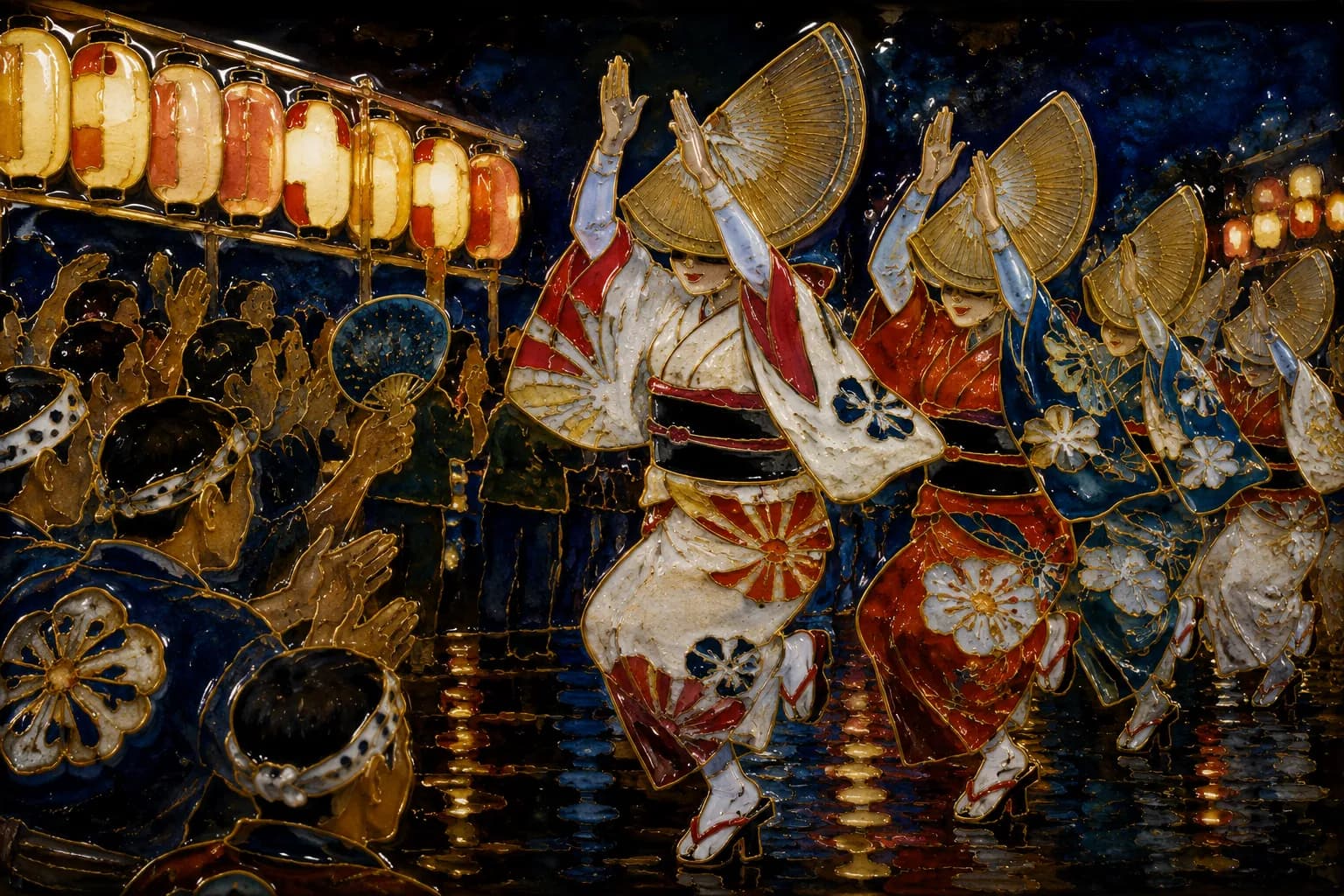
The heart of Awa Odori is the Awa Odori performance — one ren (dance troupe) after another takes the stage in turn, the men in woven hats with low, sunk steps, the women up on their toes with arms flung high, a wake of sleeves rising behind them. The sound often reaches you from the far end of the street first; before anyone is in sight, the beat has already arrived.
Where in Tokushima should you watch Awa Odori? How do you get there?
The main stage is, beyond any doubt, in Tokushima. The official advice to attendees is plain: take a bus or train to Tokushima, and come into the city to watch during the festival period (April 17 to 22).
Once you arrive, there are two ways to take in Awa Odori. The enbujo is the formal venue with seating, where troupes appear in turn and an announcer calls out each one's lineage; the streets are free, looser and more alive, where the troupes set off from the shrine and walk and dance as they go, and a bystander gets pulled in for a few steps now and then, with no one finding it odd.
My own advice is to leave time for both: first watch at the enbujo to get a clear look at the basic steps and the spirit of each ren, then slip into the streets to feel that borderless, anyone-can-dance energy.
Who is Awa Odori for?
If you ask me who this festival is for, I'd say: anyone willing to be carried along by the beat.
Tokushima has a line that has been passed down for centuries: "The dancers are fools, the watchers are fools too; since all are fools, better to dance together." The line isn't cuteness — it states the very heart of Awa Odori: between performer and onlooker there was never a clear border.
So whether you're the kind who wants to sit quietly in the enbujo and study the craft, or the kind who wants to be swept into the crowd and the smoke and bustle, there's a place for you. Bring friends, bring family, bring any companion along — that atmosphere of all being fools, yet being foolish together and gladly so, will bind everyone tightly together.
How should you plan a few days of itinerary?
The festival spans April 17 to 22, which gives you plenty of flexibility. I'd leave the daytime for Tokushima itself — wandering through the food and neighborhoods of Tokushima, getting a feel for the city's everyday life first, then giving yourself wholly over to Awa Odori once evening comes.
Awa Odori is a festival of the night. As soon as it gets dark, the streets grow hotter, with the smell of sweat, grill-smoke, and beer all stirred together; the shamisen's high plucking darts overhead, the kane strikes the beat bright and clean, and the whole street becomes one vast, breathing drum.
If you'd like to go a little further, you can fold Tokyo into the trip — in Tokyo you can climb Tokyo Tower, and you can also head to the Shinjuku district to shop. Tokushima and Tokyo, one after the other, each with its own pace of motion and stillness, come together into a journey with rises and falls of rhythm.
Transport: what should you take into Tokushima?
The official word on how to arrive is crisp: take a bus or train to Tokushima. That's what I'd recommend too — the crowds are dense during the festival, and walking the city center plus public transport is usually less of a headache than driving yourself.
Once you're in the city, you hardly need transport to watch the dancing. The enbujo and the street troupes are all concentrated in the city center; the troupes set off from the shrine and walk and dance as they go, so you follow the sound, and wherever the beat is, that's where people surge.
For schedules and last-departure times, please go by the official and operator announcements on the day — especially since the night sessions break up late, it's worth taking a look at your return route in advance.
Which area should you choose for accommodation?
Since the heart of the festival is all in Tokushima, accommodation should naturally prioritize easy back-and-forth to the enbujo and the street troupes. Staying in the city center, you can wander the food and neighborhoods of Tokushima close by during the day, and after watching the dancing at night you won't have far to travel.
Across the festival days, the city center will be the focus of the whole trip; setting your base there is, in effect, giving every single night over to Awa Odori.
If your itinerary stretches all the way to Tokyo, that's a separate arrangement — Tokyo Tower, shopping in Shinjuku; accommodation and routes will be planned to Tokyo's own pace, and can simply be looked at apart from these days in Tokushima.
Do you need to book tickets in advance? How do you estimate the cost?
Here you need to be clear about two ways of watching. Watching from the streets is free — the troupes walk and dance, and you can watch right from the roadside; this part involves no ticketing.
The enbujo, on the other hand, is a formal venue with seating; as for whether you need to arrange a seat in advance and what the related fees are, please go by the official announcement — I won't invent ticket prices or booking rules here. As a rule, if you want to be sure of a seat for the formal performances, confirming the official information early is always the safe move.
As for the overall cost, it's clearer to break it into a few pieces: the bus or train fare to and from Tokushima, accommodation in the city, food and neighborhood snacks, and the related fees if you choose to enter the enbujo. The most moving share of the bustle — the streets — actually costs nothing.
What's best to wear to watch Awa Odori?
On what to wear, the official line is very relaxed: you can wear any comfortable clothing. I fully agree, and I'd add one thing — go by what's easy to walk and move in.
The festival is a thing of the night, but the mood is fiery and the crowds dense, and watching it through is actually quite tiring on the body. The beat is fast and heavy; the taiko drives blow by blow into the chest, and at some unmarked point your head is already nodding along, then your shoulders, then your whole body in motion.
So rather than fussing over looking proper, choose an outfit that lets you fall in and copy a few steps at any moment. If a ren reaches out and pulls you in — which happens often in the streets — you'll be glad you dressed light enough to dance a clumsy, joyful stretch.
Etiquette and crowds on the scene: what should you watch for?
Awa Odori's temperament is relaxed, but relaxed doesn't mean without measure. The enbujo has seating and an announcer calling out each ren's lineage; it's a relatively orderly setting for watching, and you just follow the venue's rhythm.
The streets are freer: the troupes set off from the shrine and walk and dance as they go, and the people at the roadside draw aside of their own accord, opening a path. When you see a troupe surging toward you, going with the flow and giving way is the most natural unspoken understanding here.
As for being "pulled in for a few steps," not one person around laughs at anyone — stepping off the beat or tangling your feet is all fine; people simply let the outsiders become a length of the line too. To let go and dance is the best response to that invitation.
Is it crowded? What should you keep in mind for safety?
The city center is densely crowded during the festival — that's its charm, and also where care is needed. The whole street is like a breathing drum, growing livelier as the night deepens; when you move, look after your belongings and watch your footing — especially in the moment when a troupe surges past and everyone gives way.
For Tokushima in mid-to-late April, please go by the official and local announcements for the weather and conditions on the day; the night sessions run long, so remember to hydrate in good time and find a gap to catch your breath.
Agreeing on a meeting point with your companions in case you get separated is a small but practical habit. Once the crowd thickens and the sound is loud, having a rendezvous spot both of you know will make the whole evening more reassuring.
Why is Awa Odori 2026 worth a special trip?
Because it isn't a performance that ends once you've "watched" it. From April 17 to 22, 2026, the whole of Tokushima, across these few days, throws itself into something together — there's no border between performer and onlooker, and even you will be counted in.
Standing in the crowd, there will be an instant where you forget entirely where you are, carried along by the beat alone, with nothing left to think. That feeling of all being fools, yet being foolish together and gladly so, many people say, hasn't come along in a long while.
And the beat doesn't leave easily. Months later, on some utterly unrelated afternoon, with no warning at all, it strikes up again in your head — it can't be left behind in Tokushima; it will quietly follow you home. That, right there, is the reason it's worth a special trip.
The dancers are fools, the watchers too — so dance
Awa Odori — one imagines neat ranks in a plaza, stepping to a beat; walk into the streets of Tokushima and it proves another thing entirely. August in Tokushima is hot and clammy, sweat clinging to the back the instant it rises and refusing to leave — yet that closeness goes unnoticed: a ren, a dance troupe, surges out from a lane-mouth, a banner ahead, shamisen and taiko behind, the sound reaching from the far end of the street before anyone is in sight, the beat arriving first. Then come the dozens — men in low, sunk steps under woven hats; women up on their toes, arms flung high, a wake of sleeves rising behind them — and the bystanders draw aside of their own accord, opening a path.
Executive Summary
Festival Dates
August 12 to 15, 2026
Venue
Tokushima City
Core Event
Awa Odori performances, with one "ren" (dance troupe) after another taking the stage in turn
Two Ways to Watch
The enbujo are formal venues with seating; watching in the streets is free, with the troupes dancing as they walk
How to Get There
The official advice is to take a bus or train to Tokushima City
What to Wear
You can wear anything comfortable that is easy to walk and move in
Trip Brief
City Routes
- Wander through the vibrant Awa Odori Museum to understand the history and significance of this unique dance festival.
- Explore the beautiful Awa Odori Kaikan, a hub for all festival-related activities.
- Join in the lively street food and snack stalls, offering a variety of local delicacies.
- Learn about the cultural exchange and significance of Awa Odori in Tokyo's Shinjuku district.
- Understand the differences in dance styles and performances between Tokushima and Tokyo.
- Enjoy the Japanese street food and snacks available in Tokyo's streets.
Rules
Guidelines
Check city notices, transport timing, and opening hours separately instead of relying on one source.
If a plan includes temples or formal ceremonies, follow on-site rules and local notices.
The national holiday window and city-specific extensions can differ, so confirm city timing before final planning.
FAQ
When is Awa Odori 2026 held in Tokushima?
As scheduled, Awa Odori 2026 takes the stage in Tokushima City from August 12 to 15, 2026, lasting several days; before you travel, please go by the latest official announcement.
Where in Tokushima should I go to watch Awa Odori?
The main stage is in Tokushima City. You can watch the various ren take the stage in turn at the seated enbujo, or go to the free streets to see the troupes dance as they walk; leaving time for both is ideal.
How do I get to Tokushima City?
The official advice is to take a bus or train to Tokushima City. Once in the city, the dancing is concentrated in the downtown area, so just follow the sound; the night sessions break up late, so it's worth taking a look at your return route first.
Do I need to book tickets in advance to watch Awa Odori?
Watching from the streets is free, with the troupes dancing as they walk, and you can watch right from the roadside. The enbujo are formal venues with seating; for whether you need to arrange a seat in advance and the related fees, please go by the official announcement.
What is best to wear to watch Awa Odori?
The official line is very relaxed: you can wear anything comfortable, going by what is easy to walk and move in. The festival is at night and the crowds are dense, so light clothing lets you fall in and copy a few steps at any moment.
Where can the itinerary be extended?
The itinerary can bring in Tokyo: in Tokyo you can climb Tokyo Tower, and you can also head to the Shinjuku district to shop. Tokushima and Tokyo differ in their motion and stillness, coming together into a journey with rises and falls of rhythm.
Sources
Continue
More trip ideas
Tickets that may fit this trip