TRIPS
Editor's PickNagoshi no Harae
Trip Brief
Nagoshi no Harae is a traditional rite held at shrines across Japan around late June, especially on June 30th, centred on passing through a chinowa ring woven of kaya reeds, symbolising leaving the first half-year's i…
Quick Read
Trip Snapshot
- 01
Nagoshi no Harae is mostly held around late June each year, especially on June 30th, a traditional rite held widely at shrines across Japan, symbolising leaving the first half-year's impurities behind, and especially …
en.wikipedia.org - 02
The heart of the whole rite is passing through a chinowa ring woven of kaya reeds, tracing a figure-eight path left and right as the shrine directs; some shrines also hand over a paper figure to write your name on, br…
en.wikipedia.org - 03
Nagoshi no Harae itself requires no ticket and is mostly free to join, of a goodwill-offering nature; after leaving the shrine you can eat the seasonal minazuki, a traditional sweet of white uiro cake topped with red …
en.wikipedia.org
Half the year has passed, and the Japanese use a great ring woven of grass to gently close out the first half — this is Nagoshi no Harae, so quiet it hardly feels like a rite at all.
When is Nagoshi no Harae held?
Nagoshi no Harae is mostly held in late June, especially on June 30th — just as half the year has passed. The Japanese believe that the weariness, ill luck and small trespasses gathered without notice over these six months can all be purified away on this day, so you walk clean into the second half.
The timing varies slightly by shrine; there is no single nationwide exact date. If you plan to make a trip especially for it, I'd suggest first checking that shrine's announcement for the year and going by the official notice, then arranging the rest of your itinerary around it. My own habit is to keep the last weekend of June free, so that whichever day it falls on, there's still time to go through the ring.
Where can I take part in Nagoshi no Harae?
Nagoshi no Harae is not the exclusive event of any one shrine, but a traditional rite held widely at shrines across Japan. Many shrines set up a 'chinowa' reed ring in late June for people to pass through, and Kyoto's shrines especially are where you'll find it.
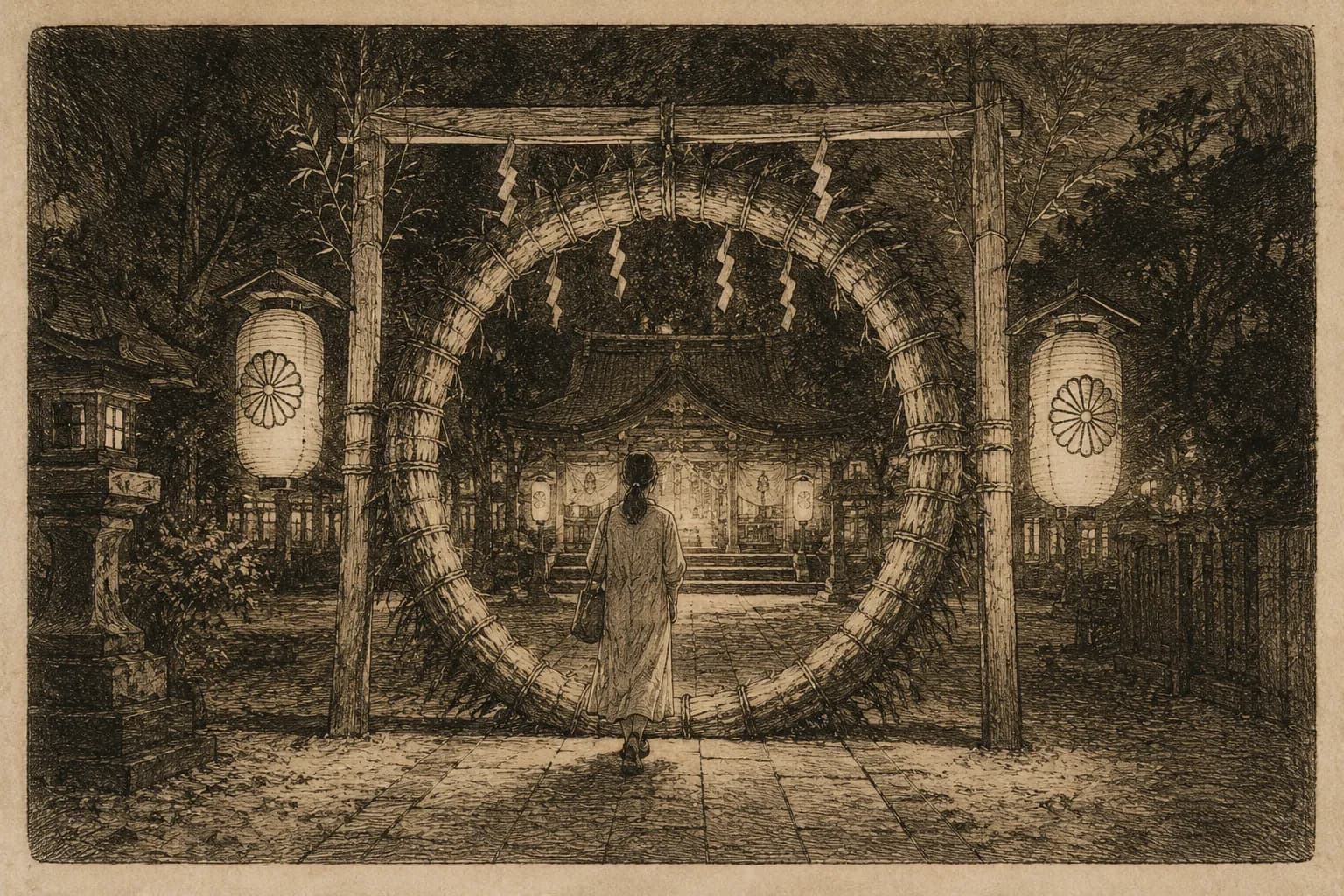
So you don't have to chase a particular place name. If you're in Japan in late June, when passing a shrine it's worth glancing beneath the torii — if you see a ring taller than a person, bound from freshly cut reeds, that's it. It usually stands at the entrance to the approach path, waiting quietly for people to walk through.
So how exactly do you pass through the chinowa?
Passing through the chinowa (chinowa kuguri) is the heart of the whole rite. The way to do it is following the shrine's guidance, tracing a figure-eight path left and right through the grass ring — usually left, right, left again, drawing a figure-eight laid on its side.
The motion is simple: walk up to the ring, stop, give a slight bow, then go around in sequence. It symbolises leaving the half-year's accumulated impurity behind. The diagram on each shrine's sign may be drawn a little differently, so just follow the local illustration — there's no need to fear getting it wrong. You can also simply follow how the person ahead of you walks.
What is the paper figure, and how do you use it?
Some shrines hand over a thin paper figure. Write your name on it, breathe onto it, then brush it lightly over your body, moving what is unclean onto the paper, and give it back to the shrine — afterwards it is floated down a river or committed to fire on your behalf.
The gesture is so light it invites doubt that it does anything. Yet afterwards the chest does loosen, just a little. Perhaps the point was never the paper, but the willingness to stop and admit to being tired too. If you're willing, this small step actually takes more time than passing through the ring — and is more worthwhile.
Who is Nagoshi no Harae suited to?
It isn't lively like a festival; there are no gongs and drums, no clamour of a crowd. The whole thing is as quiet as a low word spoken to someone — so it especially suits people who want to avoid the noise and enjoy a quiet moment.
When I was waiting in line, ahead of me was a woman who looked like an office worker, suit jacket over one arm, just off work. She wrote on the paper figure for a long time, longer than anyone, then breathed one long breath onto it, her shoulders visibly dropping before squaring again. If you and the person beside you are carrying some thing from the first half of the year and want somewhere to set it gently down, this is just right. The two of you pass through the ring one after the other, no need to speak — that quiet understanding is simply there.
How should I arrange transport and the itinerary?
Because shrines everywhere may hold it, transport is actually very flexible — there's no need to plan a dedicated route for it. The most effortless approach is to fold it into your existing June itinerary: tour the city by day, and in the evening drop by a nearby shrine on your way.
Kyoto's shrines especially abound with it, so if you were going to be in Kyoto anyway, you hardly need to plan it deliberately — you'll come across it while strolling. The only homework before going is to confirm whether that shrine has set up a chinowa that year, and roughly when it's held, going by the official notice. As for the exact date and place, please don't guess from impression; following the local announcement is safest.
Where to stay, and roughly how much does it cost?
Nagoshi no Harae itself requires no ticket — passing through the chinowa and receiving a paper figure are mostly free to join, with a goodwill-offering nature, and amount to almost no cost at all. The real spending still falls on the transport and lodging your trip already involved.
There's no need to pick lodging right next to a shrine. Choose a city base that's convenient for your daytime plans, then walk over in the evening. My suggestion is to save the budget for 'eating' — once you're out of the shrine, don't rush off; the sweets at the mouth of the lane are worth sitting down to enjoy slowly.
What is the 'minazuki' you must eat after leaving the shrine?
Out of the shrine, the sweet-shop at the lane's mouth will have 'minazuki' — a white uiro cake under a layer of red beans, cut into triangles. Some shrines also hand out this sweet to suit the occasion that day.
The triangle, they say, mimics a block of ice, and the red beans are there to ward off evil — a flavour belonging to this season alone. Buy a piece and eat it slowly on the bench by the shop door, the sweetness faint, cool, dissolving on the tip of the tongue. Half the year has simply passed — this touch of coolness is the most everyday, and most tender, close to the whole rite.
What etiquette and details should I know before taking part?
The etiquette of passing through the chinowa is very simple: walk up to the ring and give a slight bow first, then follow the shrine's guidance in tracing a figure-eight, keeping quiet throughout. It's usually very still around the ring, only the rustle of reeds stirred by the wind and a clear faint note or two of a kagura bell far off — so not being loud is the most basic understanding here.
As for crowds, Nagoshi no Harae is low-key by nature and rarely gets festival-style congestion; but at a famous Kyoto shrine, and on June 30th itself, the evening may still bring a line to queue in — just bring a little patience.
For what to wear, there's no strict rule; generally tidy clothing is enough. The heat is just rising in late June, with summer's first dampness in the air, so something more breathable will be more comfortable. As you pass through the ring the reeds graze your arm, dry and faintly itching — that is a very real sensation of this rite.
Why is Nagoshi no Harae worth a trip in its own right?
Because it is a small rite of beginning again, needing no reason at all. The Japanese do this thing of 'half-year purification' so quietly, so much a part of daily life — no grand spectacle, only a ring of grass, a thin sheet of paper, a triangular sweet.
Its value lies not in being spectacular but in that attitude of being 'willing to stop': admitting you're tired, admitting the first half of the year did leave a few things behind, and then gently setting them down. In the instant of passing through the ring, a stronger grass scent crosses the tip of your nose, and you'll understand that what this purification culture truly washes away is, perhaps, the weight in the heart.
The grass ring cannot be taken away; but the moment of passing through it — I think you will understand — feels as though something has truly been left behind.
Walk through a ring of grass, and leave half a year behind
Beneath the shrine's torii stands a great ring woven of grass, taller than a person, bound from freshly cut kaya reeds. The person ahead reaches it, stops, gives a slight bow, then passes through in a very particular way — left, right, left again, tracing a figure-eight laid on its side. No one is loud. In the late-June dusk, with the heat just risen, the air holds summer's first dampness and the faint bitter freshness of grass newly snapped.
Executive Summary
When
Mostly around late June each year, especially June 30th (2026-06-30); times vary slightly by shrine, so go by the official notice
Where
Held widely at shrines across Japan, especially common at Kyoto's shrines
Core rite
Passing through the chinowa (chinowa kuguri), tracing a figure-eight path left and right as the shrine directs
Paper figure
Some shrines hand over a paper figure (hitogata); write your name, breathe onto it, brush it over your body, and return it to the shrine to be floated down a river or burned on your behalf
Cost
It requires no ticket itself; passing through the chinowa and receiving a paper figure are mostly free to join, of a goodwill-offering nature
Seasonal sweet
Minazuki is a white uiro cake topped with red beans and cut into triangles; some shrines hand it out for the occasion that day
Trip Brief
City Routes
- Many shrines set up a chinowa ring in late June; Kyoto's shrines especially
- Pass through in a figure-eight as the shrine directs
- Some shrines hand out 'minazuki' sweets for the occasion
Rules
Guidelines
Check city notices, transport timing, and opening hours separately instead of relying on one source.
If a plan includes temples or formal ceremonies, follow on-site rules and local notices.
The national holiday window and city-specific extensions can differ, so confirm city timing before final planning.
FAQ
When is Nagoshi no Harae held?
Mostly around late June each year, especially on June 30th; times vary slightly by shrine and there is no single nationwide date, so it's best to go by that shrine's official notice for the year.
Where can I take part in Nagoshi no Harae?
It is a traditional rite held widely at shrines across Japan, especially common at Kyoto's shrines. When passing a shrine in late June, watch for whether a chinowa is set up beneath the torii.
How do you pass through the chinowa?
Following the shrine's guidance, trace a figure-eight path left and right through the grass ring, usually left, right, then left again. Give a slight bow before the ring, then go around in sequence.
What is the paper figure, and how do you use it?
Some shrines hand over a thin paper figure. Write your name on it, breathe onto it, then brush it lightly over your body and return it to the shrine, which will float it down a river or burn it on your behalf.
Do I need a ticket or fee to take part in Nagoshi no Harae?
Nagoshi no Harae itself requires no ticket. Passing through the chinowa and receiving a paper figure are mostly free to join, of a goodwill-offering nature; the main cost is still the transport and lodging your trip already involves.
What seasonal sweet can I eat after leaving the shrine?
You can eat minazuki, a white uiro cake topped with a layer of red beans and cut into triangles; some shrines also hand out this sweet for the occasion that day.
Sources
Continue
More trip ideas
Tickets that may fit this trip