TRIPS
Editor's PickGion Matsuri 2026: A Guide to Kyoto's Summer Festival
Trip Brief
Gion Matsuri is a festival spanning the entire month of July, held only in Kyoto, originating in the Heian-period "Goryo-e" rite to ward off epidemic disease. The core Yamaboko Junko procession is split into the Saki …
Quick Read
Trip Snapshot
- 01
Gion Matsuri spans the entire month of July and is held only in Kyoto; at its heart are the Yamaboko Junko processions of the Saki Matsuri on July 17 and the Ato Matsuri on July 24, while Yoiyama before the procession…
en.wikipedia.org - 02
The yamaboko are divided into "hoko" and "yama" and are hung with the brocades of each town, earning them the name "ugoku bijutsukan" (moving museums); the most thrilling moment of the procession is the "tsuji-mawashi…
en.wikipedia.org - 03
Gion Matsuri originates in the Heian-period "Goryo-e" rite to ward off epidemic disease; the yamaboko carry the wealth and the prayers for protection from disease of the townspeople of Kyoto, returning year after year…
en.wikipedia.org
What stayed with me most wasn't the float procession, but the lanterns and the gongs and drums the night before
Which days is Gion Matsuri 2026?
Gion Matsuri is a festival that runs across the whole of July, not a single-day event. At its heart is the Yamaboko Junko (the procession of huge yamaboko floats winding through the city) — the Saki Matsuri on July 17 and the Ato Matsuri on July 24, with fixed dates; while Yoiyama, on the nights of July 14–16 before the procession, is the stretch I find most enchanting. It is held only in the single city of Kyoto.
Which day should you pick?
If you can only pick one day: to see the craftsmanship of the floats and the procession lines → the morning of the July 17 procession (you have to go very early to claim a spot, standing a long time under a blazing sun); for the atmosphere, the evening yukata, the stalls and the lanterns → the evenings of Yoiyama on July 14–16. Personally I prefer Yoiyama — the procession is spectacular, but only Yoiyama gives that feeling of "stepping into the festival."
How to plan it (Kyoto in July is very hot)
Kyoto in July is hot and humid; on the morning of the procession both the crowds and the blazing sun are fierce, so bring water, a hat and a fan, and watch out for heatstroke. To watch the procession in comfort, consider the official paid grandstand seats (good spots, no need to stand a long time fighting for a place). Accommodation gets tight from early July, so book early.
What I actually walked that Yoiyama night
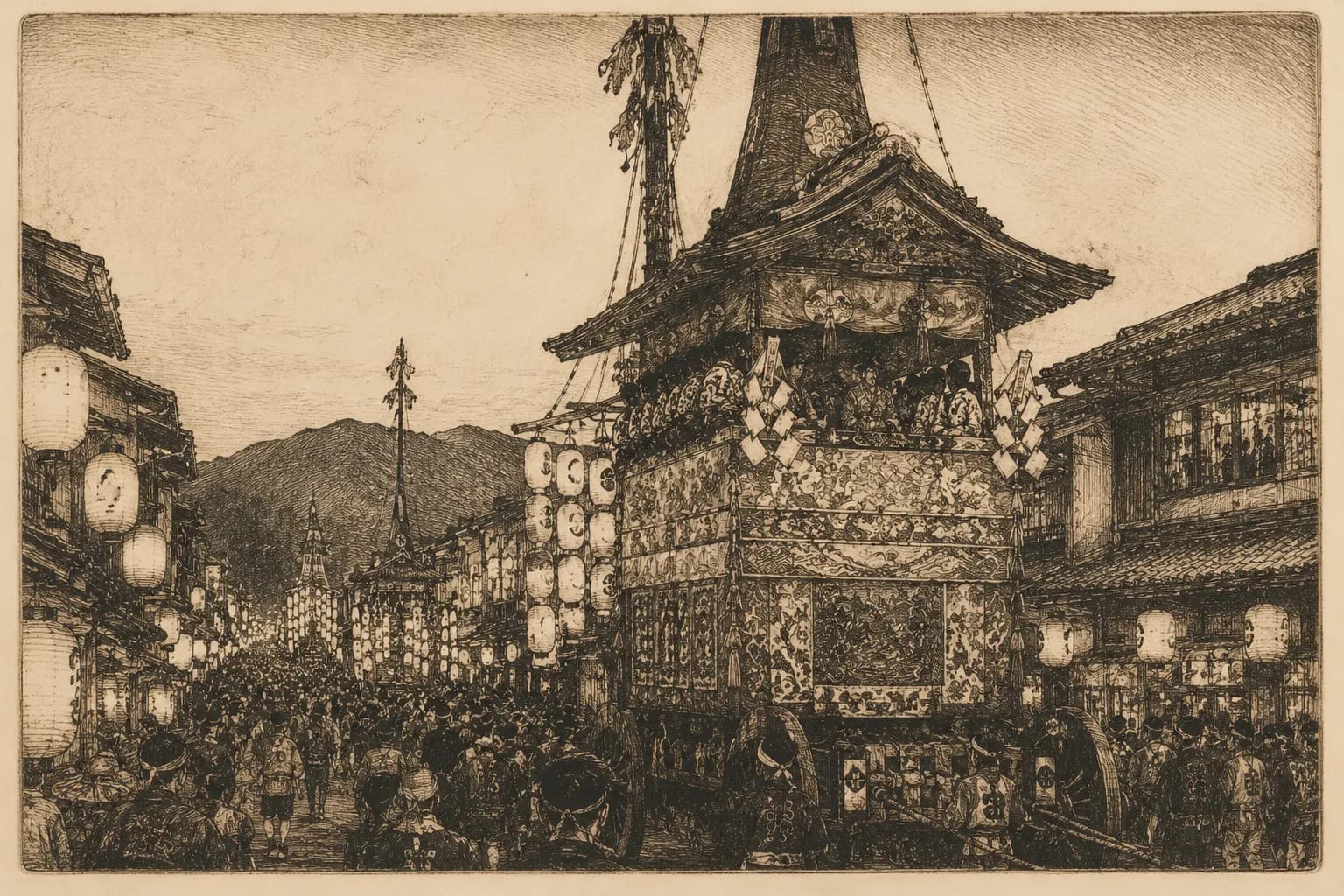
Yoiyama begins at dusk; I walked slowly north from around Shijo-Karasuma. The machiya took down their wooden shutters and lit up koma-gata lanterns one by one, the yamaboko parked at the lane mouths shining in the light so you could go close and look in detail; stalls sold takoyaki and shaved ice, people in yukata packed the narrow lanes, and now and then the gion-bayashi — gong, drum and flute — drifted down from the yamaboko. I didn't hurry, walking lane by lane, until in the end I couldn't tell whether I was watching the festival or had already been gathered into it. That sense of immersion is something the next day's procession doesn't have.
What to look for in the yamaboko
The yamaboko come in two kinds: the "hoko" are tall, standing on real timber, like a moving tower; the "yama" are smaller, carrying figures or set scenes. Each belongs to a different town and is hung with different brocades — many of them antiques and prized imported pieces, which is why the yamaboko are often called "ugoku bijutsukan (moving museums)." The most thrilling moment on procession day is the "tsuji-mawashi," where the huge wooden wheels are forced to turn at an intersection: there is no steering wheel, it's all done by hauling with manpower over wet bamboo strips, and the onlookers hold their breath together, then burst into applause. Knowing to watch this, the procession is no longer just "floats passing by."
Saki Matsuri and Ato Matsuri, what's the difference
The Gion Matsuri's yamaboko procession actually happens twice: the Saki Matsuri (July 17) is the largest in scale, with the most yamaboko and the most people; the Ato Matsuri (July 24) has fewer floats, a slower pace, and noticeably thinner crowds. If it's your first time and you want the most spectacular scene, pick the Saki Matsuri; but if you dread the crush and want to watch at ease, I'd quietly recommend the Ato Matsuri — the same craftsmanship and tsuji-mawashi, with most of the wall of people gone, so you actually see it more clearly. Each has its own Yoiyama (Saki Matsuri on the 14th–16th, Ato Matsuri on the nights of the 21st–23rd), and the mood of each is rather different too.
Why it's worth it: a thousand years of "sending off the plague"
Gion Matsuri originated in the Heian period as a "Goryo-e" to ward off epidemic disease, and those gorgeous yamaboko are a display of the wealth and the prayers for protection from disease of the townspeople of Kyoto (the merchants and townsfolk). Once you understand this layer, the yamaboko are no longer just floats — they are the people of Kyoto's prayer, over more than a thousand years, to "send the plague and calamity away," repeated year after year.
How I dodged the hottest, most crowded hours that day
Standing a long time under the blazing sun on the morning of the procession is torture. My approach was: in the morning first claim a shaded spot or one on a second floor to watch a stretch of the procession, then at noon retreat into the Nishiki Market or a café to eat and escape the heat, saving my energy for the evening. For Yoiyama I'd actually go a little later — once the daytime tour groups had dispersed and the lanterns were all lit, the lanes are at their most atmospheric. To watch the procession in comfort, you can buy the official paid grandstand seats, with a seat and no need to go at dawn to fight for a spot.
Beyond Gion Matsuri, what else to pair with Kyoto in July
Once in Kyoto, I like to stagger the festival against the rest of the itinerary: when the day is too hot, duck into temples and gardens (Kennin-ji, Nanzen-ji) to escape the heat and have a cup of matcha; in the evening cool off along the Kamogawa, looking at the "kawayuka" platforms the riverside restaurants set up; the next day wander out to Uji or Fushimi. Pairing the "bustle of the festival" with the "stillness of Kyoto" into one trip is how you hold up under July's humid heat, and it makes the journey more complete too.
Etiquette
The yamaboko and machiya are mostly cultural properties, so don't climb on or touch them; the Yoiyama crowds are enormous, so mind order and the children traveling with you; a yukata adds to the sense of taking part, but it is not required.
In July, all of Kyoto is one float
In July, the heat in Kyoto has weight. The asphalt, baked all day, scalds through a shoe's sole; the cicadas surge in from every side, layer over layer, dense enough to take on a shape, and even the wind is warm, pressing the sweat back into the skin. The old quarter's lanes are narrow and deep; round one corner and the float stands there without warning — twenty metres tall, a frame of bare timber, hung tier upon tier with Persian carpets, Belgian brocade and Chinese embroidery that crossed the seas centuries ago. Deep red, indigo, gold thread glow heavily in the slanting light, the colours so dense they seem unreal, as if time had tied a knot in this lane and could not work it loose.
Executive Summary
Festival Period
July 1 to July 31, 2026; Gion Matsuri spans the entire month of July and is not a single-day event.
Location
Held only in the single city of Kyoto.
Yamaboko Junko
Saki Matsuri on July 17, Ato Matsuri on July 24, with fixed dates; the Saki Matsuri is the largest in scale with the most yamaboko, while the Ato Matsuri has fewer and a slower pace.
Yoiyama
Yoiyama before the procession is on the nights of July 14–16 for the Saki Matsuri and July 21–23 for the Ato Matsuri, when the machiya light up koma-gata lanterns and the yamaboko can be seen up close.
Types of Yamaboko
Divided into "hoko" (tall, with a real timber mast raised like a moving tower) and "yama" (smaller, carrying figures or set scenes), hung with the brocades of each town and often called "ugoku bijutsukan" (moving museums).
Origin
Originated in the Heian period as a "Goryo-e" to ward off epidemic disease; the yamaboko are a display of the wealth and prayers for protection from disease of the townspeople of Kyoto.
Trip Brief
City Routes
- Attend the Mountain Cart procession and night festival to experience Kyoto's vibrant cultural heritage.
- Explore Kyoto's historic streets and temples during the festival, a must-see for photography enthusiasts and history buffs alike.
- Try local delicacies and drinks while walking the festival grounds, indulging in Kyoto's famous cuisine
Rules
Guidelines
Check city notices, transport timing, and opening hours separately instead of relying on one source.
If a plan includes temples or formal ceremonies, follow on-site rules and local notices.
The national holiday window and city-specific extensions can differ, so confirm city timing before final planning.
FAQ
Which days is Gion Matsuri 2026?
Gion Matsuri spans the entire month of July (July 1 to 31, 2026), not a single-day event, and is held only in Kyoto.
On which days is the Yamaboko Junko procession?
The Yamaboko Junko procession is held twice: the Saki Matsuri on July 17 and the Ato Matsuri on July 24, with fixed dates. The Saki Matsuri is the largest in scale with the most people; the Ato Matsuri has fewer floats and a gentler crowd.
What is Yoiyama and on which days is it?
Yoiyama is the evening event before the procession; the Saki Matsuri's is on the nights of July 14–16, the Ato Matsuri's on the nights of July 21–23, when the machiya light up koma-gata lanterns, the yamaboko can be seen up close, and stalls and gion-bayashi gather together.
What is the difference between the Saki Matsuri and the Ato Matsuri?
The Saki Matsuri (7/17) is the largest in scale, with the most yamaboko and the most people; the Ato Matsuri (7/24) has fewer floats, a slower pace and noticeably thinner crowds, while the craftsmanship and the tsuji-mawashi are the same in both.
What is there to look for in the yamaboko?
The yamaboko are divided into "hoko" and "yama," hung with each town's antiques and imported brocades and called "ugoku bijutsukan"; the most thrilling part of the procession is the "tsuji-mawashi," forcing the huge wheels to turn at an intersection by manpower over wet bamboo strips.
What should I watch out for when going to Kyoto in July to see the festival?
Kyoto in July is hot and humid, and both the crowds and the blazing sun in the morning of the procession are fierce, so it's advisable to bring water, a hat and a fan and watch out for heatstroke; to watch in comfort, consider the official paid grandstand seats, and book accommodation early.
Sources
Continue
More trip ideas
Tickets that may fit this trip