TRIPS
Editor's PickSat Thai
Trip Brief
Sat Thai is held in the tenth lunar month, the season when Thais make offerings to their ancestors. With the new grain just harvested, people simmer roasted rice, peanut, sesame and palm sugar into the sweet Krayasart…
Quick Read
Trip Snapshot
- 01
Sat Thai is Thailand's ancestor festival held in the tenth lunar month; with the new grain just harvested, people simmer roasted rice, peanut, sesame and palm sugar into Krayasart, offering it first to the monks, then…
en.wikipedia.org - 02
Temples all across Thailand hold Sat Thai almsgiving and offerings, with a thicker atmosphere around Nakhon Si Thammarat in the south; go at dawn to catch the most complete offering scene.
en.wikipedia.org - 03
This is a low-spend, quiet and understated seasonal festival, with no parade or fireworks, folding the new harvest and remembrance of ancestors into one small sweet.
en.wikipedia.org
In the tenth lunar month, Thais use a sweet made of the just-harvested grain to tie the new crop to their ancestors — this is Sat Thai, the ancestor season hidden in everyday life.
What festival is Sat Thai?
Sat Thai falls in the tenth lunar month, the season when Thais make offerings to their ancestors. The new grain has just come in, and people simmer roasted rice fragrance, peanut, sesame and palm sugar together into a sticky sweet called Krayasart, offering it first to the monks, then dedicating it to departed kin.
It is not raucous; it is a season hidden in the everyday, unannounced — you might not even notice it had come. One mouthful of sweetness thanks the land's harvest and remembers those who went on ahead — joining the new harvest to remembrance is the heart of Sat Thai.
When is Sat Thai? How is the date worked out?
Sat Thai falls in the tenth lunar month, which converts to roughly somewhere between September and October on the solar calendar.
Note that the Thai calendar is a lunar system and does not map fixedly onto the solar calendar, so the exact day shifts each year. To pin down the date precisely, the safest approach is to check that year's official announcement before you set out, going by the official announcement, and not to apply last year's dates.
In my own experience, rather than fixating on which exact day, it is better to keep the whole stretch of the tenth lunar month in mind; a dawn visit to a temple will often let you catch the almsgiving and offerings.
How do you take part in the south, especially in Nakhon Si Thammarat?
Temples all across Thailand hold Sat Thai almsgiving and offerings, but the atmosphere is usually thicker in the south.
In the south, Sat Thai often joins some local festivals, making the celebration livelier, and the area around Nakhon Si Thammarat is especially worth noting. If your schedule allows, a trip south will let you feel the weight of this festival more easily than in central Bangkok.
Taking part is actually very simple: go to a temple at dawn, join the almsgiving and the offering, and then find a piece of Krayasart to taste near the temple or at the market. No sign-up, no threshold — just follow the rhythm of the locals.
Who is Sat Thai suited for?
If you like quiet, understated travel, Sat Thai will suit you well. There is no grand parade or fireworks, only the sweet thing handed over with care, and then sitting down to eat a mouthful of the same sweetness — the whole thing is quiet, as if speaking low to someone.
Travelers who want to understand Thai ancestor culture, who want to see how a seasonal sweet is made, or who simply want to avoid crowd-type festivals will all find their own pace here.
It also suits those carrying something on their mind. That sweetness of grain and palm sugar easily recalls the things at home that appear only at certain festivals.
How do you plan the trip? Transport, where to stay, costs?
Transport and lodging: Sat Thai activities are concentrated at temples in each area, and the south, around Nakhon Si Thammarat, is livelier. If experiencing the southern atmosphere is your focus, you can arrange lodging in a town center where temples are relatively concentrated, so a morning walk or short hop to the temple is most convenient.
Timing: Going at dawn lets you feel the atmosphere best; almsgiving and offerings mostly take place early in the morning, and the earlier you arrive, the more complete the scene you will see.
Cost: This is a low-spend festival. Give to the almsgiving as you are able; Krayasart can be bought at the market and near temples, a small piece is not expensive, and it is a seasonal sweet you can savor over and over. Saving the budget to buy a few more pieces and eat them slowly actually fits the spirit of this festival better.
Offerings and merit-making customs — what etiquette should you know?
Sat Thai's core offering is Krayasart — a traditional sweet simmered from the season's new grain, peanut, sesame and sugar, made only at this season. The faithful offer one portion to the monks and keep one silently in the heart for the person they miss.
There are no complicated rules of etiquette, but entering a temple still calls for basic decorum: dress properly, soften your steps, and do not disturb those making offerings to the monks. Offering is handing over the sweet thing with care; the intention matters more than the form.
About crowds: because this is not a raucous-type festival, most temples will not be packed, and dawn is even more peaceful. Occasions in the south where it joins other festivals will draw more people, but the overall tone stays quiet.
What does Krayasart taste like? How do you choose it?
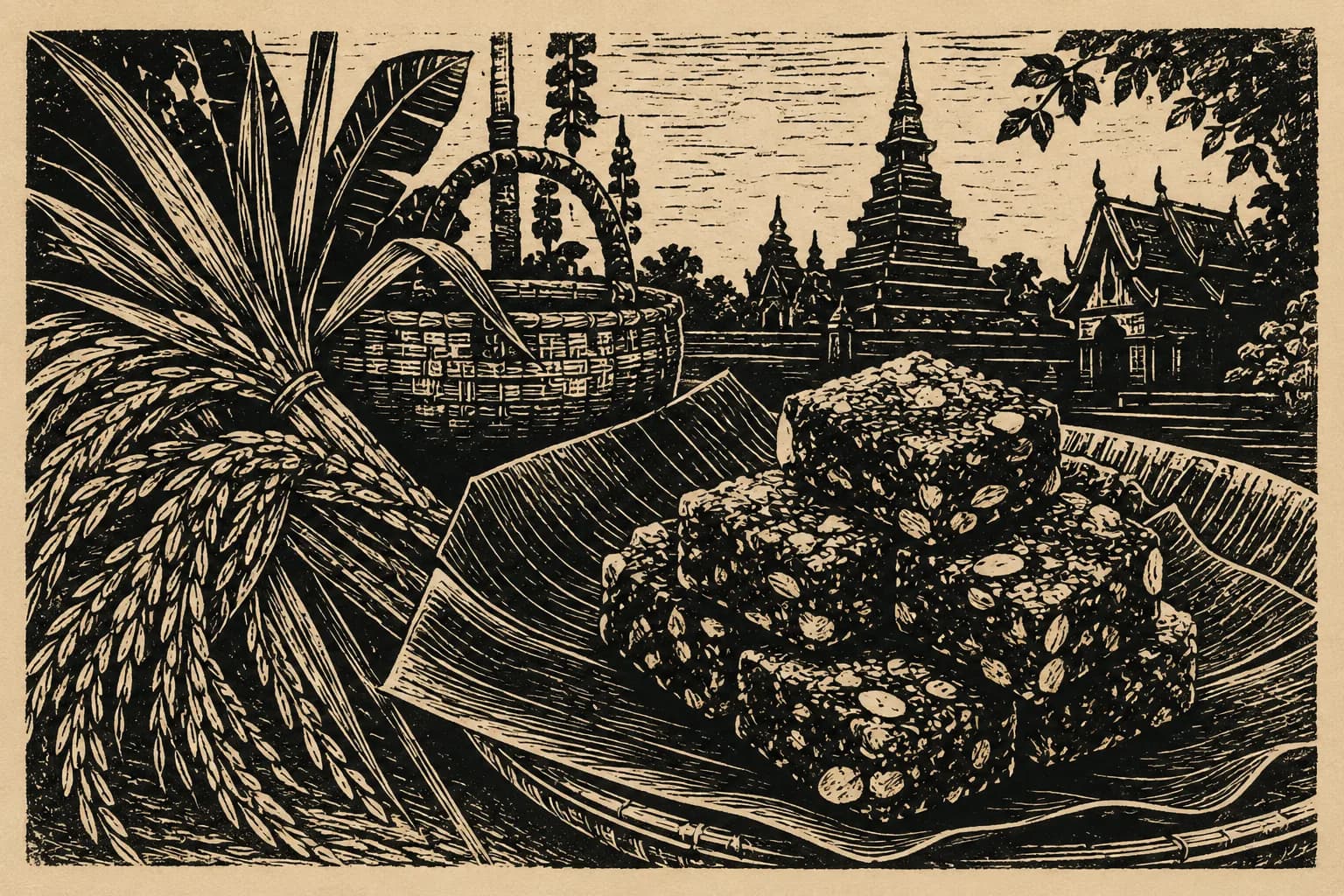
Krayasart is dark brown and sticky, threaded with grains of peanut and sesame. In its sweetness there is a scorched fragrance of just-roasted grain and the thick sweetness of palm sugar, clinging to the fingertips — that taste belonging to autumn, to the just-harvested.
I bought a small piece at the market; biting in, the peanut breaks apart in the mouth, the roasted-rice fragrance spreads on the tongue and slowly fades, and the sweetness clings to the teeth, making you eat slowly without realizing it.
The vendor told me that making this recipe means watching the heat — stir too slow and it scorches, too fast and it will not bind — and that many people's craft was handed down from their grandmother's generation. When choosing, look for the stall making it fresh, with the fragrance just drifting out; that one usually won't go wrong.
Why is Sat Thai worth a trip?
Sat Thai is one of Thailand's autumn seasonal festivals, folding the new harvest and remembrance of ancestors into one small sweet.
Its goodness lies not in scale but in that quietness. Under the trees outside the temple it is cool, cicadas in waves; sitting to eat a piece of Krayasart slowly, you will find that wherever one is, people use a mouthful of seasonal sweetness to remember the same thing: that some people, though gone, are still remembered by a taste.
This trip will not give you lively photos, but it will give you a very quiet afternoon, and a name you have not thought of in a long time. I think if you too taste this mouthful, you will likely understand.
What's sweet isn't the sugar — it's the fact of "just harvested"
In a corner of the market sits a sweet one had not noticed before — dark brown, sticky, threaded with grains of peanut and sesame. The vendor says it is called krayasart, made only at this season. A small piece bought: in its sweetness a scorched fragrance of just-roasted grain and the thick sweetness of palm sugar, clinging to the fingertips, that taste belonging to autumn, to the just-harvested.
Executive Summary
Date
2026-10-11 (tenth lunar month; varies each year by the Thai lunar calendar, follow the official announcement)
Season
Tenth lunar month, which converts to roughly between September and October on the solar calendar
Location
Held at temples all across Thailand; the atmosphere is thicker around Nakhon Si Thammarat in the south
Core offering
Krayasart, a traditional sweet simmered from the season's new grain, peanut, sesame and sugar
Meaning
Joining the new harvest with remembrance of ancestors; offered first to the monks, then dedicated to departed kin
Suggested time
Dawn; almsgiving and offerings mostly take place early in the morning
Trip Brief
City Routes
- Held at temples nationwide; livelier in the south where it joins local festivals
- At dawn you can join the almsgiving and offering at a temple
- Krayasart is sold at markets and near temples — try the seasonal sweet
Rules
Guidelines
Check city notices, transport timing, and opening hours separately instead of relying on one source.
If a plan includes temples or formal ceremonies, follow on-site rules and local notices.
The national holiday window and city-specific extensions can differ, so confirm city timing before final planning.
FAQ
What festival is Sat Thai?
Sat Thai is held in the tenth lunar month, the season when Thais make offerings to their ancestors. People offer the new-grain sweet Krayasart to the monks, then dedicate it to departed kin, joining the new harvest with remembrance.
When is Sat Thai? How is the date worked out?
It falls in the tenth lunar month, which converts to roughly between September and October on the solar calendar. The Thai calendar is a lunar system, so the exact day shifts each year; before you set out, please go by that year's official announcement.
What is Krayasart?
It is Sat Thai's core offering, a traditional sweet simmered from the season's new grain, peanut, sesame and sugar. Dark brown and sticky, it carries a scorched grain fragrance and the sweetness of palm sugar, and is made only at this season.
Where is the best place to take part?
Temples all across Thailand hold almsgiving and offerings; the atmosphere is usually thicker in the south, and the area around Nakhon Si Thammarat is especially worth noting. Going at dawn lets you feel the atmosphere best.
How do you take part? Is there a threshold?
It is very simple: go to a temple at dawn to join the almsgiving and the offering, then find a piece of Krayasart to taste near the temple or at the market. No sign-up, no threshold.
What etiquette should you observe at Sat Thai?
Keep basic decorum when entering a temple: dress properly, soften your steps, and do not disturb those making offerings to the monks. The intention of offering matters more than the form; give to the almsgiving as you are able.
Sources
Continue
More trip ideas
Tickets that may fit this trip