TRIPS
Editor's PickTakayama Festival
Trip Brief
The Takayama Festival is a mountain-town festival in Hida-Takayama, Gifu Prefecture — the collective name for the spring Sanno Matsuri and the autumn Hachiman Matsuri — and, together with Kyoto's Gion Matsuri and the …
Quick Read
Trip Snapshot
- 01
The Takayama Festival is the collective name for the spring Sanno Matsuri and the autumn Hachiman Matsuri, belonging respectively to Hie Shrine and Sakurayama Hachimangu, and, together with Kyoto's Gion Matsuri and th…
en.wikipedia.org - 02
The floats are three-storey-tall wooden floats, black lacquer traced with gold, designated as important cultural properties; some are fitted with karakuri puppets that, drawn by ropes and gears, can flip over and take…
en.wikipedia.org - 03
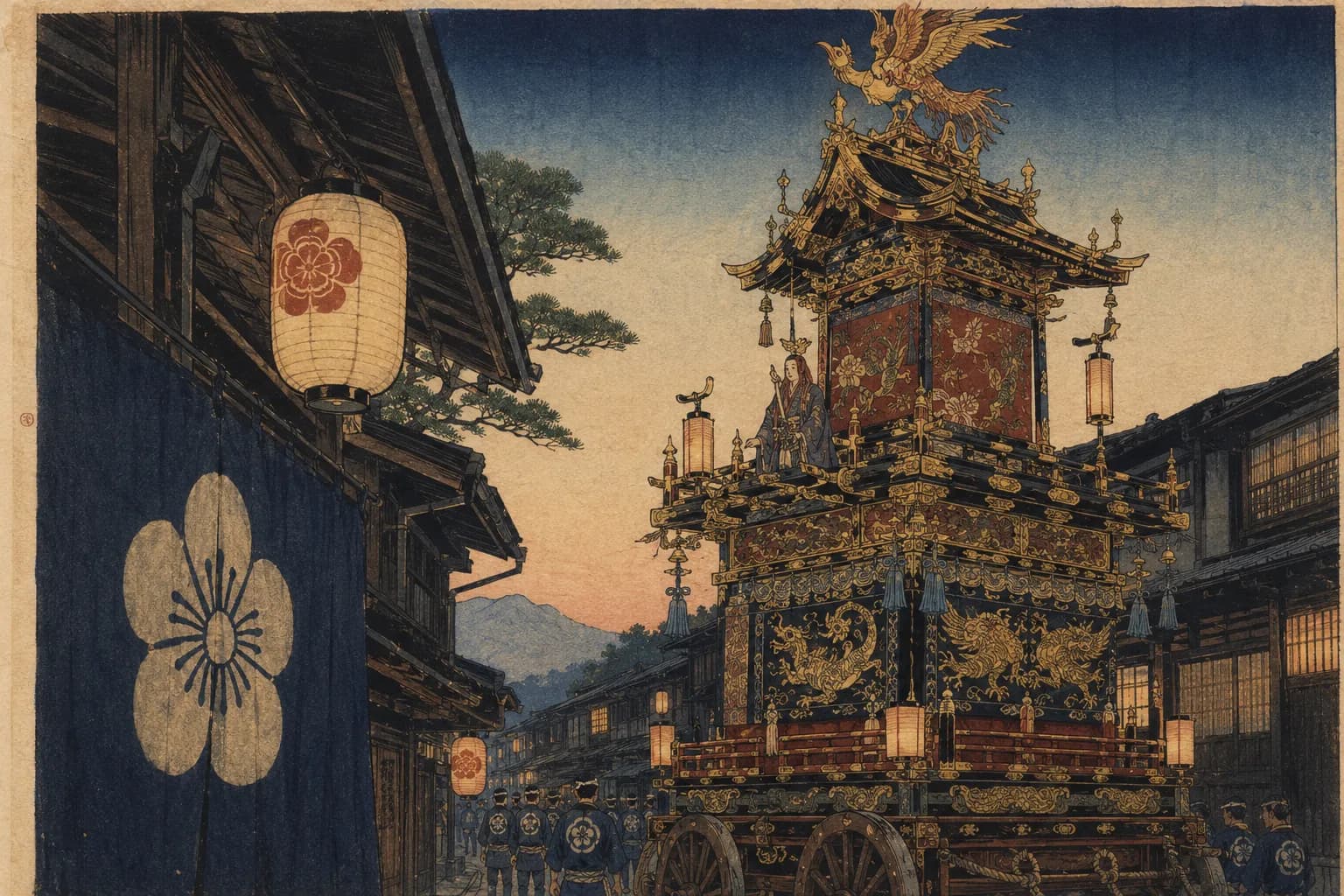
The old town of Hida-Takayama preserves rows of Edo-era wooden townhouses, the very stage the float procession passes through; after nightfall the floats hang lanterns and become the yoi-matsuri.
en.wikipedia.org
A Hida mountain-town festival held twice a year — watch the walking wooden floats and mechanical puppets pass slowly before your eyes in the chill of spring and the cool of autumn.
When is the Takayama Festival held? How do the spring Sanno Matsuri and autumn Hachiman Matsuri differ?
I have to get this straight first, because a lot of people only realize they've mixed it up once they arrive. The Takayama Festival is actually the shared name of two festivals, not one event held twice.
The spring one is called the Sanno Matsuri, in April, the rite of Hie Shrine; the autumn one is called the Hachiman Matsuri, in October, belonging to Sakurayama Hachimangu. The two belong to different shrines, different seasons, and even the floats brought out and the procession routes differ — so if you already have a particular float in mind that you want to see, it's best to confirm which of the two you're choosing.
As for the exact day, I won't pin it down. The precise dates vary slightly each year, so please follow the official notice. Just keep the broad frame in mind — "spring in April, autumn in October, two distinct festivals" — and you won't book the wrong season.
How big a deal are the two of them together?
Put the two together and the weight becomes clear. The Sanno Matsuri and the Hachiman Matsuri are together called the Takayama Festival, and together with Kyoto's Gion Matsuri and Chichibu's night festival they are known as Japan's three most beautiful festivals.
The reason they're called "beautiful festivals" lies entirely in those floats. Hida is a land of mountains and little farmland, long famed for its craftsmen — even the great temples of Kyoto and Nara sent for Hida carpenters. And these floats are what that skill became, poured out in full when there was no temple to build: travelling works of art, one after another. Three storeys tall, black lacquer traced with gold, dragons, phoenixes, scrolling vines, the carving and metalwork so fine you must step close to see them.
Where is the Takayama Festival? How do you get to Hida-Takayama?
The stage for the festival is Hida-Takayama in Gifu Prefecture, and the whole procession takes place in its old town.
For transport, most people take a limited-express train from Nagoya, a ride of about two-plus hours. Once you arrive, the old town isn't large; you can basically explore on foot, and the floats move among these narrow lanes and street corners, so you don't really need to transfer to anything else.
My own experience is that, rather than working out the shortest route on a map, it's better to leave time to wander slowly through the town — where the floats stop will change, and following the direction of the crowd, you'll often run into one at some corner.
Who is this festival for?
If you love seeing genuine traditional craftsmanship and have a feeling for wooden architecture and old-town atmosphere, this place will keep you here a long time. The floats are designated cultural properties — not stage scenery, but real objects restored over many generations.
It also suits people who aren't rushing their itinerary and are willing to stand a while longer where they are. The festival's rhythm is slow: the floats pass inch by inch, and the mechanical puppets won't move until the masters have strung each line one by one.
My companions that day were a band thrown together in the inn's lobby — a few travellers who had never met, drawn by the same float to the same corner. If you, too, come with that kind of open spirit, you'll easily find yourself standing shoulder to shoulder with the person beside you over the same float.
How do you plan it? Transport, where to stay, how to link up with the night festival?
The skeleton of the trip can be built like this.
Transport: From Nagoya, take a limited-express train into Hida-Takayama, about two-plus hours — this is the main axis; once in town, switch to walking.
Where to stay: Staying in the old town or within walking distance makes your evening yoi-matsuri go much more smoothly — because the night festival comes on right after the daytime ends, and staying close means you won't have to leave early to catch a train.
How to fill the day: Beyond the float procession, you can wander the Sanmachi old streets and the Miyagawa morning market; these are all within the town, and you'll arrive just by walking.
How to link up with the night festival: After dark comes the yoi-matsuri, with the floats hung with hundreds of lanterns for the nighttime procession. Splitting the experience into two parts — the close look at the daytime craft and the lantern-lit atmosphere at night — is the arrangement I find most comfortable.
What exactly are you looking at with the floats?
The floats are ornate wooden floats, designated cultural properties. Even standing still, that black-lacquer-traced-with-gold carving and metalwork is worth circling once to see — dragons, phoenixes, scrolling vines, something growing on every inch.
But the most breath-holding part is the karakuri carried on some of the floats — the mechanical puppets worked by ropes and gears. A handler hidden within works dozens of fine strings, making a wooden figure flip in midair, take up a brush and write, then toss itself to another puppet to be caught; no electricity, no motor through it all, only string, wood, and a pair of hands trained over a lifetime. The instant the puppet succeeds, the whole crowd lets out one "ohh," a sound likely no different from two hundred years ago.
How does the night festival differ from the daytime?
By day you look at the detail of the craft; at night you look at the atmosphere.
In the yoi-matsuri after dark, the floats hang hundreds of lanterns and the whole float floats up out of the dark, gold lacquer catching candlelight, dimming and brightening, drifting slowly from one end of the lane to the other. The warm scent of lamp oil, the smell of the mountain town's timber houses at night, the thin far flute of the bayashi all hang together in the cool spring-night air.
That night a few strangers stood shoulder to shoulder, hardly speaking, only looking up at that orb of gold light passing inch by inch. If you've already looked closely at the floats by day, then at night put the camera down and simply stand and watch the lights pass by — that's the advice I'd give.
What you should know: crowds, weather, and the etiquette of watching the floats
A few practical things are easier taken in hand beforehand, to keep you at ease.
Crowds: As one of the three most beautiful festivals, with the procession concentrated in the narrow lanes of a not-large old town, it gets crowded. The corners where the floats stop are especially packed; to see the mechanical puppet performance, you'll have to stake out a spot early.
Weather: April in Takayama still holds a little spring chill, the air cold and clear, faintly sharp to breathe in; the evening yoi-matsuri is also a cool spring night. The October autumn festival likewise calls for watching the morning-and-evening temperature swing. In short, bring a jacket, especially if you're staying for the night festival.
Etiquette: The floats are important cultural properties, and things the locals have poured several generations of effort into. I've watched a puppet-master, his performance done, slowly coil the strings loop by loop, his movements slow to the point of reverence. Toward something like this, keeping your distance and not forcing your way up to touch it is the most basic respect.
Why is it worth making a special trip?
Because this is a kind of craft that walks, that is alive.
The craftsmen who carved it are long gone, yet the float still moves. You can't take it away — and likely none of those strangers could either — but the night it lit up out of the dark and passed slowly before the eyes, each of them tucked into their own pack.
Hida-Takayama's old town keeps rows of Edo-era wooden townhouses, the very stage the float procession passes through; the floats themselves, the mechanical puppets, the lights in the night, plus this mountain town still holding its old-day appearance — these four things happen layered together. I think that, years from now, if you too meet such a walking lantern in some small town, you'll be as we were that night, standing a while longer where you are, loath to see it turn the next corner too soon.
The wooden thing outlives the hands that carved it
The yatai stands in a narrow lane, three storeys tall, black lacquer traced with gold, its carving and metalwork so fine one must step close to see them — dragons, phoenixes, scrolling vines, something growing on every inch. It is a yatai, the float drawn through the streets at the Takayama Festival, brought to this state by Hida craftsmen across many generations. April in Takayama still holds a little spring chill, the air cold and clear, faintly sharp to breathe in, the smell of wood and raw lacquer clean to the point of transparency.
Executive Summary
When it's held
Spring Sanno Matsuri April 14–15, 2026; autumn Hachiman Matsuri October 9–10
Location
The old town of Hida-Takayama, Gifu Prefecture; the procession winds through narrow lanes and street corners
The two editions
The spring festival is the regular rite of Hie Shrine; the autumn festival belongs to Sakurayama Hachimangu, with different floats and routes
Yatai floats
Three-storey-tall wooden floats, black lacquer traced with gold, designated as important cultural properties, some fitted with karakuri puppets
Night festival
The yoi-matsuri after nightfall, when the floats hang hundreds of lanterns and parade at night
Getting there
Most go by limited-express train from Nagoya, about two-plus hours; the old town can be explored on foot
Trip Brief
City Routes
- From Nagoya, a limited express reaches Hida-Takayama in about two-plus hours
- Two editions a year; the lantern-lit night procession is the one to catch
- By day, wander the Sanmachi old streets and the Miyagawa morning market
Rules
Guidelines
Check city notices, transport timing, and opening hours separately instead of relying on one source.
If a plan includes temples or formal ceremonies, follow on-site rules and local notices.
The national holiday window and city-specific extensions can differ, so confirm city timing before final planning.
FAQ
When is the Takayama Festival held?
The Takayama Festival is split into two editions: the spring Sanno Matsuri in April and the autumn Hachiman Matsuri in October. In 2026 the spring festival is April 14–15 and the autumn festival is October 9–10; the exact dates are subject to the official announcement.
What is the difference between the spring Sanno Matsuri and the autumn Hachiman Matsuri?
The spring Sanno Matsuri is the regular rite of Hie Shrine, held in April; the autumn Hachiman Matsuri belongs to Sakurayama Hachimangu and is held in October. The two belong to different shrines and different seasons, and the floats brought out and the procession routes also differ.
What is there to see in the floats at the Takayama Festival?
The floats are three-storey-tall wooden floats, black lacquer traced with gold, designated as important cultural properties. Some floats are fitted with karakuri puppets worked by ropes and gears, able to perform actions such as flipping over and taking up a brush to write.
Where is the Takayama Festival held, and how do you get there?
The festival takes place in the old town of Hida-Takayama, Gifu Prefecture. Most people go by limited-express train from Nagoya, a ride of about two-plus hours; once there, the old town is not large and can be explored on foot.
What is the difference between the night festival and the daytime?
By day you see the detail of the float craft and the karakuri puppets; in the yoi-matsuri after nightfall, the floats hang hundreds of lanterns and parade at night, the gold lacquer catching the candlelight as they move slowly from one end of a lane to the other.
Besides watching the floats, what else can you do during the day?
Beyond the float procession, you can also wander the Sanmachi old streets and the Miyagawa morning market within the old town; these spots are all within the town area and reachable on foot.
Sources
Continue
More trip ideas
Tickets that may fit this trip