Essay
Hundreds of thousands walk nine days beside one palanquin
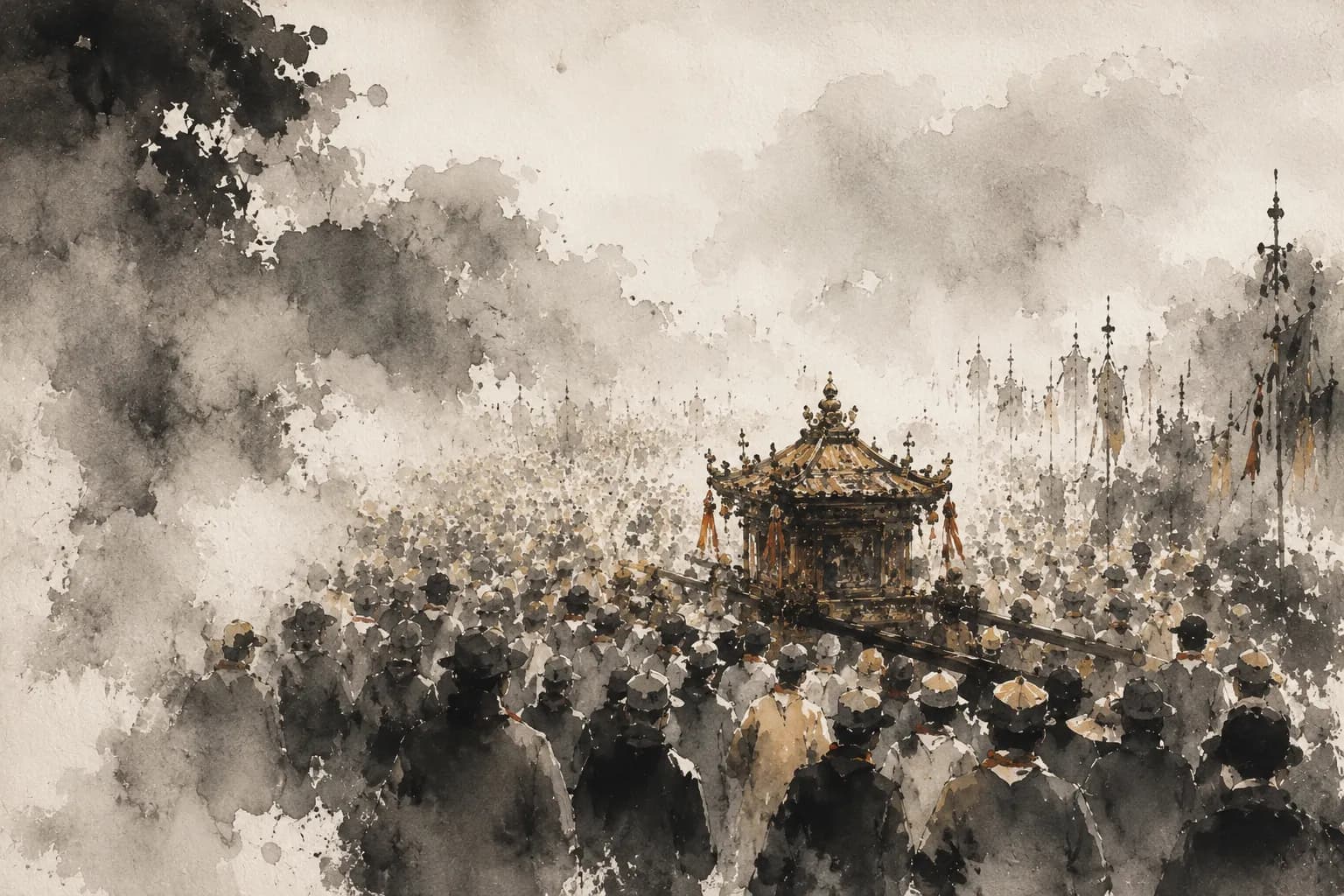
Hundreds of thousands of people, nine days, over three hundred kilometres — the Dajia Mazu pilgrimage is a thing on that scale. Packed into the procession, firecrackers bursting at the feet, the smoke not yet cleared when the palanquin presses up close, the gunpowder stinging the eyes. No time to think — kneeling with the old man beside, forehead to the scalding asphalt, letting the palanquin be borne slowly over the head. In that instant the roar of hundreds of thousands seems suddenly to recede far off, leaving only the asphalt's burn, the firecrackers' lingering smoke, and overhead a swaying sheet of gold.
This palanquin sets out from Zhenlan Temple in Dajia, Taichung, heading south through Taichung, Changhua and Yunlin to Fengtian Temple in Xingang, Chiayi, then back the same way — nine days and eight nights, three hundred and forty kilometres round trip, past a hundred temples and more than twenty towns. That gesture just now is called zuan jiao jiao: devotees lie flat on the ground and let Mazu's palanquin pass over them, the most treasured blessing of the whole road. It is among the largest religious events on earth, yet walking inside it, what one feels is never "the largest," but one concrete person beside another, and another.
Households along the way carry tables to their doors, handing out lunchboxes, water, pain-relief patches; under the eaves pots of free misua noodles simmer. An old woman presses a bowl into one's hands, telling you to restore your strength before walking on, the bowl scalding, the broth boiling, the scent of chopped scallion and sweat going straight up the nose. No one asks where you are from, or whether you believe; on this road you are simply one more person walking behind Mazu.
Walk long enough and the soles are all blisters, the asphalt's heat seeping up inch by inch through the shoes, yet no one can stop, because no one around stops. Our group had never met, only fallen in together on the road: someone repaying a vow, someone praying peace for a sick mother, someone who cannot quite say why, who simply comes to walk every year. An old man up front carried a pilgrimage flag gone white with age on his back; he said he had walked over thirty years, replaced the flag many times, his pace slower each year.
After dark the procession walks on. Gongs and drums near and far, incense smoke drawn into threads under the streetlamps, footsteps, chanting, a child's crying, all kneaded into this road with no beginning and no visible end. One does not finish the whole route, dropping out at some town whose name will not come, the soles all blisters; yet the rhythm of being pushed along by the crowd is still in the body even lying down at night.
That bowl of noodles from a stranger, that palanquin borne over the head, that old man with his faded flag, stayed on a long while after. I think you too will find, as we did: you cannot take Mazu with you, but you take away how the people on this road treat a person they have never met — and that, perhaps, is more like a miracle than any miracle.
Essay