TRIPS
Editor's PickSongkran Festival 2026: A Celebration of Thai New Year
Trip Brief
Songkran is the Thai New Year, following the solar calendar, with the official 2026 dates set for April 13 to 15. Bangkok concentrates around Silom and Khao San Road, like a huge city party; Chiang Mai, with the moat …
Quick Read
Trip Snapshot
- 01
Songkran follows the solar calendar, with the official 2026 dates set for April 13 to 15. The dates are nearly fixed, so flights and accommodation can be planned early, and the closer to this window, the more sought-a…
en.wikipedia.org - 02
Bangkok and Chiang Mai are two different intensities of experience: Bangkok concentrates around Silom and Khao San Road, like a city party; Chiang Mai, with the moat ringing the old city, has a more traditional atmosp…
en.wikipedia.org - 03
Songkran is not just water throwing; bathing the Buddha and pouring water over elders' hands are its blessing essence, and in 2023 it was inscribed on UNESCO's list of the Intangible Cultural Heritage of Humanity.
en.wikipedia.org
A guide written by someone who has walked the ground, scouting everything you need to know in advance for you
Let's get the most important thing out of the way first: when to go
Songkran is not a lunar festival; it follows the solar calendar, so the dates are almost fixed—the official 2026 holiday runs April 13 to 15. The upside of this is that you can book your flights and rooms very early; the downside is that all of Asia knows about these three days, so flight prices and Chiang Mai room rates jump up around this window, and the later you book, the more expensive it gets.
My advice is to treat April 13 as the core, leaving a day of flexibility on each side: arrive on the 12th, lock down your spot, and gather your gear; the 13th to 15th is the main event; leave the 16th for a slow itinerary to wind down, and dry out your soaked things along the way.
Bangkok or Chiang Mai? I've been soaked in both
Songkran in Bangkok and in Chiang Mai feel like two different things. Bangkok concentrates on the entire closed-off Silom street and the Khao San Road area, more like one giant city party: the music is loud, the crowds are huge, the play is wild and uninhibited, and when you're tired you can turn around to an air-conditioned mall or convenience store. If you also want to sightsee in Bangkok and care about easy transport, Bangkok suits you—but remember, those few days the ground traffic is nearly paralyzed, so your accommodation absolutely must be right by a BTS Skytrain station.
Chiang Mai is another intensity. The entire moat rings the old city, which amounts to a circular water battlefield; wherever you walk you're in it, and even the temples, the old city gates, and the night market all get wet too, more traditional, and with more of that feeling of "the whole city celebrating the New Year together." If you can only pick one, and it's your first time, I'd tell you to go to Chiang Mai—the price is that you have to book accommodation a few months early, as rooms inside the old city are hard to come by. In one line: for balancing sightseeing and convenience choose Bangkok, for experiencing Songkran at its most intense choose Chiang Mai, and for pairing it with a beach go to Pattaya.
The first mistake I made was booking the hotel in the wrong place
That time I went cheap and booked a hotel a twenty-minute walk from the old city. Sounds fine, right? But during those Songkran days, taxis and tuk-tuks are almost impossible to hail, the roads are closed, and that twenty minutes turned into twenty minutes of being soaked through, hauling luggage and walking against the crowd, my shoes full of water; by the time I reached the hotel I looked like I'd just been fished out of the river. Only afterward did I understand: in Chiang Mai you should stay inside the old city or by the moat, so you can walk to the main battleground; in Bangkok you must pick a hotel along the BTS Skytrain, because during the water-throwing period ground transport will be paralyzed, and the BTS is the only reliable option. (If you're also carrying a phone, passport, and cash, just prepare two waterproof bags—one for the phone, one for documents—and wrap them in an extra layer with a ziplock bag. This was the most useful few dozen baht of my whole trip.)
What to wear into the water, what to carry on the street
On the first day I wore a cotton tee with canvas shoes, and the result was the cotton tee got wet, heavy and see-through, and the canvas shoes were still not dry the next day. By the second day I'd wised up: quick-dry moisture-wicking clothing, and a pair of sandals or sports slippers you don't mind getting wet; if you wear light-colored clothes, remember to wear an undergarment. Bring only the cash you need for the day, hung around your neck in a waterproof bag; unless your camera has a waterproof case, don't bring it—those days the air is full of water, and the lens can hardly be spared. Bring along a thin towel or scarf too, so when you're tired of the splashing you can wipe your face, and you can also cover your shoulders when entering a temple.
The water battle on the ground—what does it actually feel like
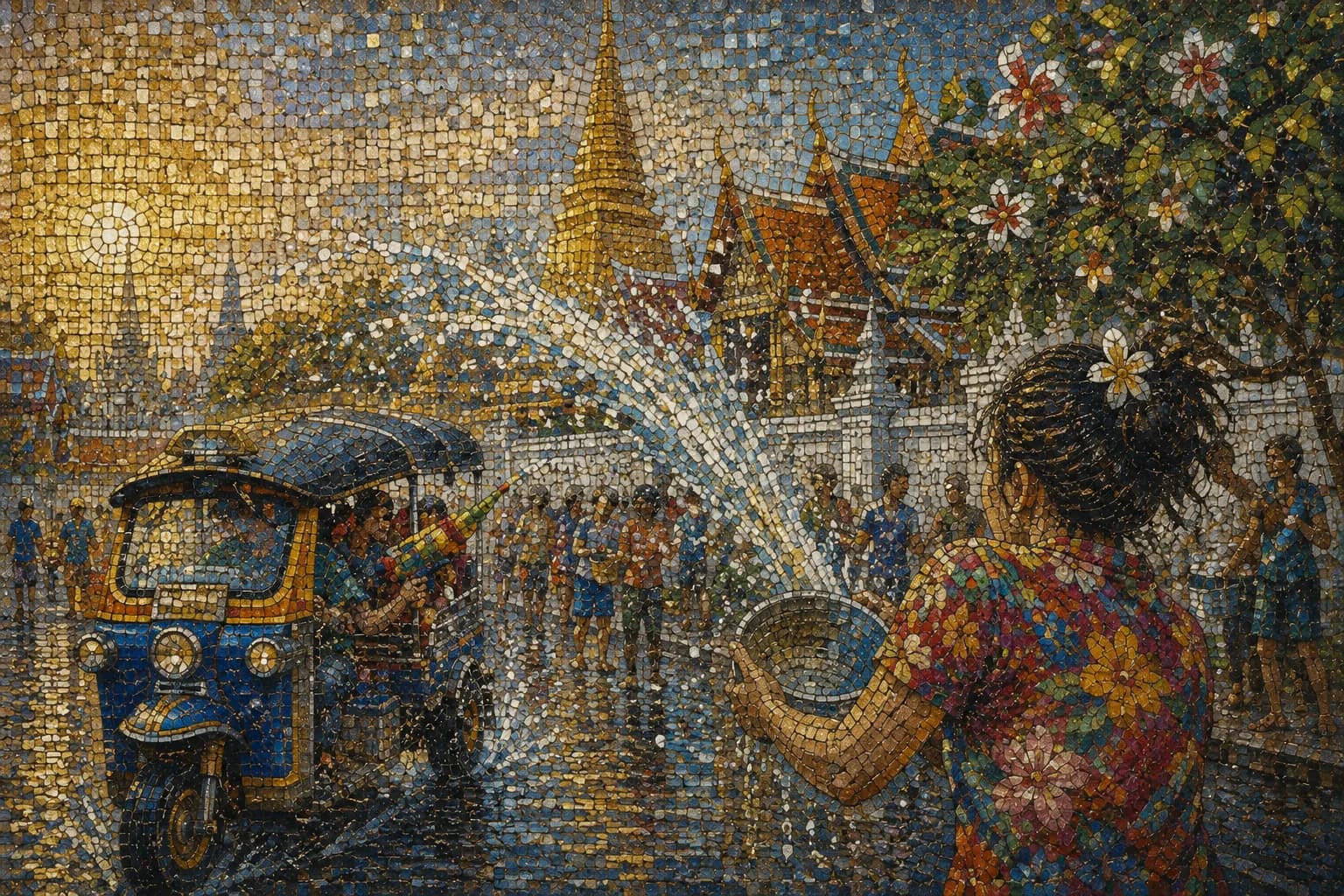
After noon, the whole moatside turns into a flowing wall of water. Some people use hoses to pump water from the moat, some hold buckets with ice cubes added (the moment ice water is poured over your head, you'll be as awake as if you'd been reset), pickup truck beds passing by are packed with people, splashing while playing Thai songs. The air is warm, the water is cool, the ground is all splashes reflecting the sun, and the whole street glitters. You can't "spectate"—the moment you step onto the street, within three seconds you'll be soaked, and then you'll find yourself laughing too, splashing right back at the stranger beside you who just splashed you. That kind of madness where "no one in the whole city is dry, and no one is a stranger" I haven't encountered anywhere else. After playing until three or four in the afternoon, find a roadside stall to sit down, order a plate of pad krapow moo with iced black tea, and watch the outside keep getting drenched—those were the most comfortable fifteen minutes of my whole trip.
How my three days actually went
Day one (arrive 4/12): the moment the flight landed, I could smell the pre-festival restlessness. I first dropped off my luggage, went to the supermarket to buy a water gun and two waterproof bags, in the evening took a loop around the old city to scout out the spot I'd lock down the next day, then ate a bowl of khao soi to build up my strength and went to bed early.
Day two (4/13, the main event): before nine in the morning, the Tha Phae Gate area had already kicked off. I spent almost the whole day soaking by the moat, ducked under the eaves at noon to eat and recover, then fought on again until sundown in the afternoon; after nightfall the entire Nimman Road looked like it had just been through a heavy rain, everyone wet, everyone laughing.
Day three (4/14–15): the intensity didn't let up, but I learned the rhythm of "recharge in the morning, go to battle in the afternoon," and deliberately set aside half a day to visit the quieter temples and markets. A reminder: everyone's stamina is different, but "soaking in water all day" will tire you more than you imagine, so be sure to leave breathing periods, stay hydrated, and don't drink alcohol on an empty stomach.
But it really isn't just a water fight
I too originally thought Songkran was just a giant water-throwing party. Until that early morning, when in a temple I saw people quietly pouring water over Buddha images, then gently pouring scented water into the palms of elders—that is called "bathing the Buddha" and offering blessings. Songkran was inscribed on UNESCO's list of the Intangible Cultural Heritage of Humanity in 2023; the original meaning of throwing water is to wash away the old year's ill luck and to bless the new year. Once I understood this layer, the water hitting my face in the afternoon felt different—it's not just cool, it's someone wishing you good luck.
One old man made me understand this festival
On the afternoon of the wildest day of the water battle, I saw an elderly gentleman holding a small bowl of water mixed with jasmine, not joining the melee, but walking up to an elder in a wheelchair by the roadside, gently pouring the water into the other person's palm, and both of them smiled. That scene was completely out of sync with the surrounding splashes and screams, yet it pulled me back at once to what Songkran originally looked like—it's not about throwing as fiercely as possible, but about "handing your blessing to the people you care about." In the days that followed, whenever I saw someone pouring water over hands like this, I would unconsciously slow down. When you go, pay attention to scenes like this too—that is the part of this festival I remember most.
Etiquette, and the pitfalls I've stepped on for you
A few lines the locals care about a lot but tourists often cross: don't splash monks, elders, or people who clearly don't want to play; toward elders it's "pouring over the hands" to show respect, not dousing over the head; don't use ice water, and don't aim high-pressure water guns at people's faces. There's also a practical reminder—traffic accidents rise noticeably during Thailand's long-holiday period, and the local media report on it every year, so drink within your limits and watch the road conditions, play wild but don't play to the point of an accident.
Where the money roughly goes, and is it worth it
Honestly, Songkran itself costs almost nothing—going out to throw water is free, and water guns and waterproof bags are small change. The real cost is flights and accommodation, and because all of Asia is eyeing these three days, prices in this window run high, and the later you book the more expensive it gets. My takeaway is: rather than booking accommodation far away to save money, put your budget into "a room in the right location"—those days transport will be paralyzed, and staying close = saving a great deal of commuting and misery, so that money is the most worth spending. (The actual amounts fluctuate a lot each year, so go by the current official or partner page; I'm not writing fixed prices here.)
If I had two extra days, this is how I'd extend it
If you've flown all this way specially, I'd suggest staying two extra days, and not letting your itinerary be only "wet." In Chiang Mai, I'd go up Doi Suthep to look out over the whole city, go to the Sunday Walking Street for snacks, and find an old-city café to daydream in for half a day; in Bangkok, after the water battle turn to the Grand Palace, Wat Pho, or a riverside night market, just right for pairing the "loud" and the "quiet" into one complete trip. This is also why I booked my return flight a little later—Songkran is the climax, but it shouldn't be the whole of this trip.
If I did it over again, this is how I'd plan it
Book Chiang Mai old-city accommodation a few months early, bring two waterproof bags, go to a temple in the early morning to watch the Buddha-bathing before getting into the water (you'll first get the quiet side, then the wild side), leave all of April 13 for the grandest event, carry only that day's cash, and leave the camera at the hotel. By the second day, I'd arrange a slower itinerary to wind down—ride up Doi Suthep for a glimpse of the whole soaked city, or duck into a café, dry my shoes at the door, sip an iced latte, and watch the people on the street still getting wet. What Songkran gave me was not a video to show off, but an April of being "splashed with a whole bodyful of good luck by the entire city." If you're going too, remember: put your phone away, and hand yourself over.
You will be soaked through, and then you will fall for this place
One knows within the first second of leaving the hotel. The street is not even in focus when something drenches the back — turning round, it is a child of about ten, hoisting a water gun longer than himself, beaming the most pleased of grins this way. This is Chiang Mai in April, the second day of Songkran, the Thai New Year. The back soaked through, the sun fierce, and yet a laugh escapes — and to laugh is to surrender: from here on, the whole street takes you for a target.
Executive Summary
Official Dates
April 13 to 15, 2026
Nature of the Festival
Thai New Year, following the solar calendar, with dates nearly fixed
Bangkok Main Venue
Concentrated on the closed-off Silom street and the Khao San Road area; accommodation is best chosen near a BTS Skytrain station
Chiang Mai Main Venue
The moat rings the old city, forming a circular water battlefield; the atmosphere is more traditional, and accommodation inside the old city must be booked several months in advance
Cultural Status
Inscribed on UNESCO's list of the Intangible Cultural Heritage of Humanity in 2023
Traditional Rituals
Bathing the Buddha and pouring water over elders' hands (rot nam dam hua), symbolizing washing away the old year's ill luck and offering blessings
Trip Brief
City Routes
- Explore the city's water-based events and activities
- Visit famous temples and try traditional Thai cuisine
- Experience the city's vibrant nightlife and street food
- Join the city's Songkran festivities and water fights
- Visit the famous Chiang Mai Night Bazaar and try local street food
- Explore the city's ancient temples and ruins
- Relax on the beautiful beaches and enjoy water activities
- Visit the famous Pattaya Floating Market and try local seafood
- Explore the city's vibrant nightlife and entertainment options
Rules
Guidelines
Public holiday: Some businesses and institutions may adjust operating hours during Songkran.
Local etiquette: If a visit involves temples or formal ceremonies, follow on-site guidance and local notices.
FAQ
Which days is Songkran in 2026?
The official 2026 holiday dates are April 13 to 15. Songkran follows the solar calendar and the dates are nearly fixed, so you can arrange flights and accommodation early.
Should I choose Bangkok or Chiang Mai for Songkran?
Choose Bangkok if you want to balance sightseeing with convenient transport; choose Chiang Mai if you want to experience the most intense Songkran atmosphere; consider Pattaya if you want to pair it with a beach.
Where should I stay in Bangkok and Chiang Mai?
During the water throwing in Bangkok, ground traffic becomes paralyzed, so it is best to pick a hotel along the BTS Skytrain; in Chiang Mai, it is best to stay inside the old city or by the moat, so you can walk to the main battleground.
What is there besides water throwing at Songkran?
Songkran has the customs of bathing the Buddha and pouring water over elders' hands to wish them blessings. The original meaning of throwing water is to wash away the old year's ill luck and to bless the new year, and in 2023 it was inscribed on UNESCO's list of the Intangible Cultural Heritage of Humanity.
What etiquette should I be aware of when joining Songkran?
Do not splash monks, elders, or people who clearly do not want to play; toward elders, pour water over their hands to show respect rather than dousing them over the head; also do not use ice water or aim high-pressure water guns at people's faces.
What gear should I bring to enjoy Songkran?
It is best to wear quick-dry moisture-wicking clothing and sandals or sports slippers you don't mind getting wet, and remember to wear an undergarment with light-colored clothes; carry the day's cash and documents in a waterproof bag, and if your camera has no waterproof case it is best to leave it at the hotel.
Sources
Continue
More trip ideas
Tickets that may fit this trip