TRIPS
Editor's PickBun Bang Fai Rocket Festival
Trip Brief
Bun Bang Fai is a traditional festival of the Isan region in northeastern Thailand, usually held in May before the rainy season arrives. Villagers fire large homemade rockets skyward to ask the heavens for rain and pr…
Quick Read
Trip Snapshot
- 01
The Rocket Festival is a traditional festival of the Isan region, usually held in May before the rainy season arrives; villagers fire large homemade rockets skyward, asking the heavens for a rain with boom after thund…
en.wikipedia.org - 02
The festival is most representative in Yasothon Province, reachable by road from Bangkok or Ubon. The launches are preceded by rocket parades and dance, lively by day and carrying on into the night, so it's best to le…
en.wikipedia.org - 03
The large rockets are dangerous, some standing several metres tall. When watching, be sure to stay in the designated viewing area, well clear of the launch pad, and follow the directions of the on-site staff; don't ed…
en.wikipedia.org
In the Isan fields before the rains come, villagers fire great rockets they built with their own hands into the sky, asking the heavens for rain with one thunderous boom after another.
So when exactly is the Rocket Festival?
The Rocket Festival (Bun Bang Fai) is usually held in May, falling right before the rains arrive. This isn't a randomly chosen date — Isan's land often goes short of water, so everyone races to fire their rockets into the sky before the rainy season as a way of asking heaven for rain, hoping the coming season will bring steady rain and a steady harvest.
A word of caution: the Rocket Festival has no fixed, nationwide "this-month-this-day" date. It runs on the arrangements of each village and town; Yasothon's is the grandest, but the exact dates are still decided by local announcement each year. So before you actually go, please rely on the official announcement for that year, and don't lock in your flights based on nothing more than "some weekend in May."
Where is the festival held? How do you get there?
The stage for the Rocket Festival is in the Isan region of northeastern Thailand, and among its locations, Yasothon is the most representative — the place most worth setting your sights on.
As for getting there, Yasothon can be reached by road from Bangkok or from Ubon. In practice, most people first fly or take a vehicle to one of Isan's big cities (for example, around Ubon), then transfer to an overland vehicle into Yasothon; going straight from Bangkok works too, only the distance is longer, so it's best to budget your travel time generously — don't let yourself get stuck commuting and miss the daytime parade.
Who is this festival for?
If you love the kind of heat where "the whole field roars together," the Rocket Festival is probably a good fit for you. It isn't the sort of occasion where you sit quietly and watch a performance — when a rocket flies well, the whole crowd cheers together; the teams whose rockets fail or veer off are shoved, to everyone's laughter, into the mud pool beside, and they climb out caked in mud, laughing loudest of all.
I especially recommend coming with a group of friends. I've seen a few people who only meant to watch from a distance get completely swept into the mood, ending up splashed with mud, shoes soaked through — yet not one of them wanted to leave. Set laughing by the same rocket and splashed into the same mud together, that kind of pure delight is probably something only this place can give. People who dislike getting dirty, dislike noise, or want a quiet itinerary may want to think it over a little.
How should you plan the trip? How do you judge transport and timing?
Setting Yasothon as your core point, then connecting in from Bangkok or Ubon, is the smoothest way to go. The Rocket Festival is lively by day and carries on into the night: before the launches there are ornate rocket parades and dance, the daytime is the main event of parading and firing, while the night is a different kind of liveliness. So in planning, do your best to be on-site by day, and don't spend the whole morning on the road.
I'd suggest leaving at least one full day for the launches and the parade, and folding in the night's continued festivities if you have energy to spare. One rocket falls back into the field, and the next is set on the rail — the rhythm keeps rolling on, so give yourself a little slack in your timing to keep up with that momentum.
Where's a more convenient place to stay?
Since Yasothon is the grandest and most representative location, arranging your lodging near Yasothon will save you the most effort, letting you watch the parade and launches by day and join the night's festivities without long-distance trekking.
If rooms are scarce in Yasothon itself, falling back on Ubon as your base and making a same-day round trip is also a workable option — after all, Yasothon can be reached by road from Ubon in the first place. The key is not to let your lodging sit too far from the venue, or the back-and-forth transport will eat into your time at the field's edge.
How much should you budget? Do you need to book ahead?
The core experience of the Rocket Festival — standing at the field's edge watching rocket after rocket rise, swept up by both the atmosphere and the mud — is by itself a very street-level, very local occasion. What actually costs money is mainly transport and lodging to and fro: the fares from Bangkok or Ubon to Yasothon, and a local room during the festival.
As for bookings, the things most worth handling early are lodging and transport. During the Rocket Festival the crowds pour in to Yasothon, so rooms and seats on transport will be tighter than usual — the earlier you arrange them, the more at ease you'll be. As for the viewing itself, the point isn't grabbing a spot but standing in the right place — that part will be covered in the next section.
What should you know on-site? Dress, etiquette, and crowds
First, the atmosphere: standing outside the safety line, the smell of powder in your nose, your ears still ringing, the sun baking the back of your neck hot. These few lines are really just the on-site reality, so for dress, go by the principles of sun-resistant, dirt-resistant, easy to walk in, and easy to get wet — there's a good chance you'll be baked by the sun here and splashed by mud, and shoes getting into the mud water is a common thing, so don't wear clothes and shoes you'd be loath to dirty.
As for crowds, Yasothon's is the grandest, and the daytime parade and launches both gather large crowds, so the flow of movement is more crowded — leave yourself a little extra buffer time for getting around. As for etiquette, this is a rain-asking ritual that everyone is earnestly carrying out, with villagers winding their prayers round and round into the powder, their expressions graver than a groom's at a wedding — going to watch with a heart of respect will bring you closer to the festival than treating it as mere spectacle.
What's the single most important thing to watch for safety-wise?
This is the one point on the whole trip you can least afford to take lightly: the large rockets are dangerous. The Yasothon area is the most exacting; some rockets stand several metres tall and take several men to carry, and the recoil at launch leaves even the ground faintly numb.
So be sure to stay in the designated viewing area, well clear of the launch pad, and follow the directions of the on-site staff. Those few short seconds of quiet before each ignition, when the whole crowd holds its breath — that tautness is there for a reason. Don't edge toward the launch pad just to get a closer shot; the safety area is the safety area precisely because that force is no joking matter.
Why is the Rocket Festival worth a trip of its own?
Because beneath all this clamour lies a very plain, very earnest wish. A very old legend is told here: the Toad King, Phaya Khankhak, led all beings up to heaven to demand rain from Phaya Thaen, the god who rules the rains, and having won, the god promised — so long as people made rockets and sent sound up to the sky, he would send the rain down. So these thunderous reports are that ancient pact, still earnestly kept every year.
In a place that lives by the weather, what everyone says with the loudest sound and the highest rocket is in fact the simplest of phrases: let it rain. And village against village, over whose rocket flies highest and hangs longest, has been quietly competing all year — the more face for the village that built that rocket. What you see is not just fireworks; it's a whole year of thought streaking up into the sky in those few short seconds.
If the travel you want is one that truly steps into the lives of local people, set alight over one thing together with a band of friends, then these Isan fields will give you a stretch of pure delight that's hard to replicate.
Fire a rocket you built yourself into a sky that has been dry too long
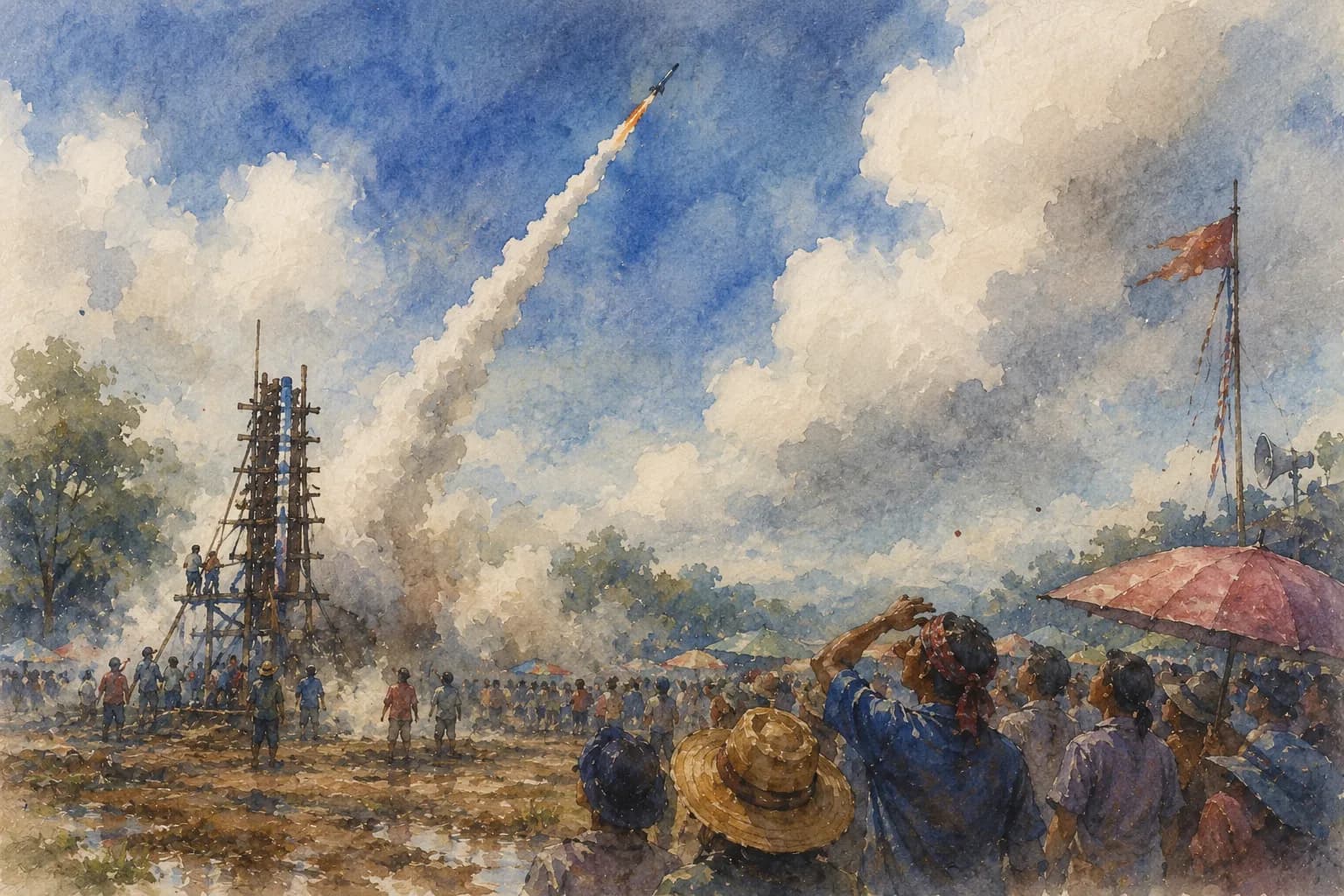
A stir beside the launch rail, the fuse lit, a hiss — and a rocket longer than a man tears up into the sky trailing white smoke, everyone tipping their heads back to chase that smoke until it shrinks to a point and vanishes. The air is all the scorch of gunpowder, the ground left faintly numb by the recoil, the tremor still in the soles. Then the cheering — the higher it flies, the longer it hangs, the more face for the village that built it.
Executive Summary
When
2026-05-08 to 2026-05-10, usually before the rains arrive in May; exact dates announced locally each year
Where
The Isan region of northeastern Thailand, with the Yasothon Province event being the most representative
Getting there
Yasothon can be reached by road from Bangkok or Ubon
Highlights
Villagers launch and compete with large homemade rockets, preceded by rocket parades and dance
Meaning
Asking the heavens for rain and praying for a good harvest, competing for the highest and longest-flying rocket
Safety
The large rockets are dangerous; stay in the designated viewing area, well clear of the launch pad, and follow on-site directions
Trip Brief
City Routes
- Yasothon's festival is the most famous; reach it by road from Bangkok or Ubon
- Before the launches come ornate rocket parades and dance — lively by day, on into night
- Rockets are dangerous — stay in the designated viewing area, well clear of the launch pad
Rules
Guidelines
Check city notices, transport timing, and opening hours separately instead of relying on one source.
If a plan includes temples or formal ceremonies, follow on-site rules and local notices.
The national holiday window and city-specific extensions can differ, so confirm city timing before final planning.
FAQ
When is the Rocket Festival held?
Usually in May, before the rainy season arrives; the 2026 event falls on May 8 to 10. It has no nationwide fixed date, and the exact day is decided by local announcement each year.
Where is the Rocket Festival held, and how do you get there?
The stage is in the Isan region of northeastern Thailand, with Yasothon Province being the most representative. Yasothon can be reached by road from Bangkok or Ubon; it's best to budget your travel time generously.
Why are the rockets fired into the sky?
Isan's land often goes short of water, and villagers believe firing homemade rockets skyward asks the heavens for rain and prays for a good harvest, while competing over whose rocket flies the highest and stays aloft the longest.
What safety points should I watch for on-site?
The large rockets are dangerous, some standing several metres tall. Be sure to stay in the designated viewing area, well clear of the launch pad, and follow the directions of the on-site staff.
Where is it more convenient to stay?
Arranging your lodging near Yasothon saves the most effort, letting you watch the parade and launches by day and join the night's festivities without long-distance trekking; if rooms are scarce locally, you can use Ubon as a base and make a same-day round trip.
How should I dress on-site?
Go by the principles of sun-resistant, dirt-resistant, easy to walk in, and easy to get wet; there's a good chance you'll be baked by the sun and splashed by mud, and shoes getting into the mud water is common, so don't wear clothes and shoes you'd be loath to dirty.
Sources
Continue
More trip ideas
Tickets that may fit this trip