Essay
A procession walking slowly out of a thousand years ago
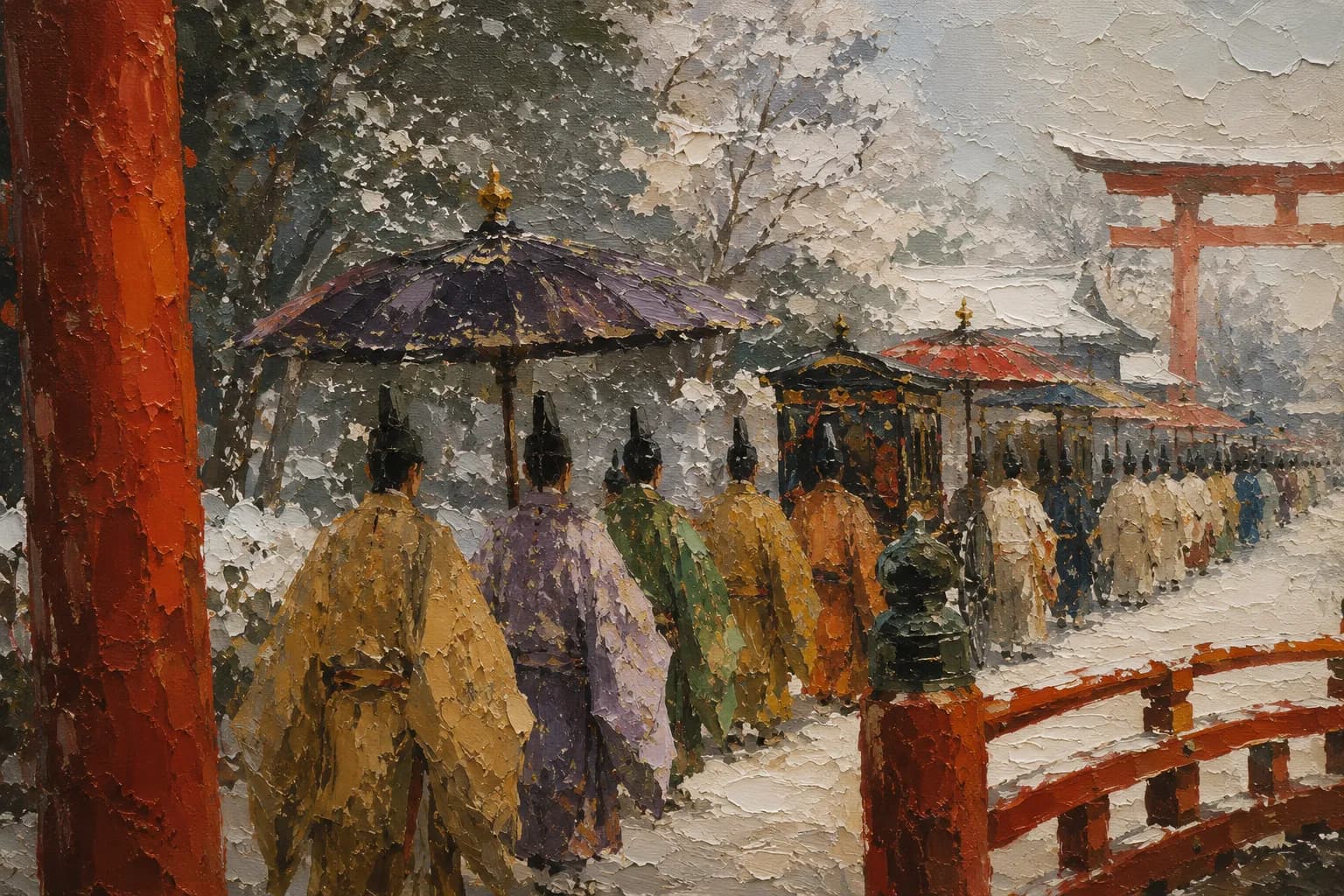
The instant the procession appears, time seems to tilt, just slightly. May in Kyoto is not yet hot; the wind floats with the green of new leaves and the cool of the Kamo River. One stands at a crossing waiting for a light — and then hundreds of people in Heian-era dress come slowly out of the Kyoto Imperial Palace, robes in colours seen only on old scrolls, blue, scarlet, deep purple, layered one over another; even the ox drawing the cart has been decked the whole way with hollyhock leaves, its hooves on the asphalt dull and slow, one step, one pause. No one hurries, the whole procession so slow that one's own breathing eases without noticing, and the phone in the hand sinks quietly down.
The Aoi Festival is held every May 15th, and with the Gion and Jidai festivals it is one of Kyoto's three great festivals — the oldest of the three. Its origin legend reaches back over fourteen centuries: in years of failed harvest and spreading plague, the emperor sent an imperial envoy to make offerings to the Kamo gods and pray for kind seasons — and that was the beginning of the Kamo Festival. Only later, because procession, shrines and houses were all decked with aoi (hollyhock) leaves, did it come to be called the Aoi Festival. In the Heian era, to say merely "the festival" was to mean this one.
It relies on no clamour, no drifting dash; what it wants is a single word — slow — to walk the courtly grandeur of a thousand years ago, untouched and quiet, once more down the streets of modern Kyoto. In the procession is a young woman under a heavy crown, her face painted white to near-transparency, her expression unmoving from start to finish: the Saio-dai, the festival's central figure. Watching her pass, one suddenly grasps it — she is carrying, with her whole body, the weight of a thousand years, step by step forward. An old man at the roadside murmured "Saio-dai," his tone familiar, as if introducing an old friend.
The procession sets out from the palace, walking all the way to Shimogamo Shrine and then to Kamigamo Shrine — eight kilometres, from morning into afternoon. From every crown, every breast, even the eaves of the ox-carts, hangs the aoi-katsura: futaba-aoi leaves twined onto katsura sprigs, the divine crest of the two Kamo shrines, the fresh leaves giving off a faint grass-green scent in the sun. I watched a boy leading a horse for a long while; sixteen or seventeen, fighting to keep his back straight — yet as he passed he let out a quiet long breath: even in a procession from a thousand years ago, someone is nervous.
The procession recedes, the hoofbeats and the ox-carts' wooden axles fading together, the street settling back into an utterly ordinary May afternoon, the wind just wind again. Yet those slowly moving colours still linger behind the eyes, slow to disperse. I was like that too that day, unable to turn straight to the next sight, standing a while longer where I was, letting that blue and scarlet sink slowly into me.
Some things, once seen, must be given time. The slowness of the Aoi Festival means just this: it quickens not half a step to please anyone, only stubbornly, year after year, takes a whole day to walk a long-vanished age back into flesh and blood. The walking done, that age slips back into history, to be ushered out again, step by solemn step, at this time next year. And I think that if you too have stood once at that roadside, you will understand: some slowness is a grandeur you cannot see.
Essay