Essay
The day before ordination, he is carried like a prince on shoulders
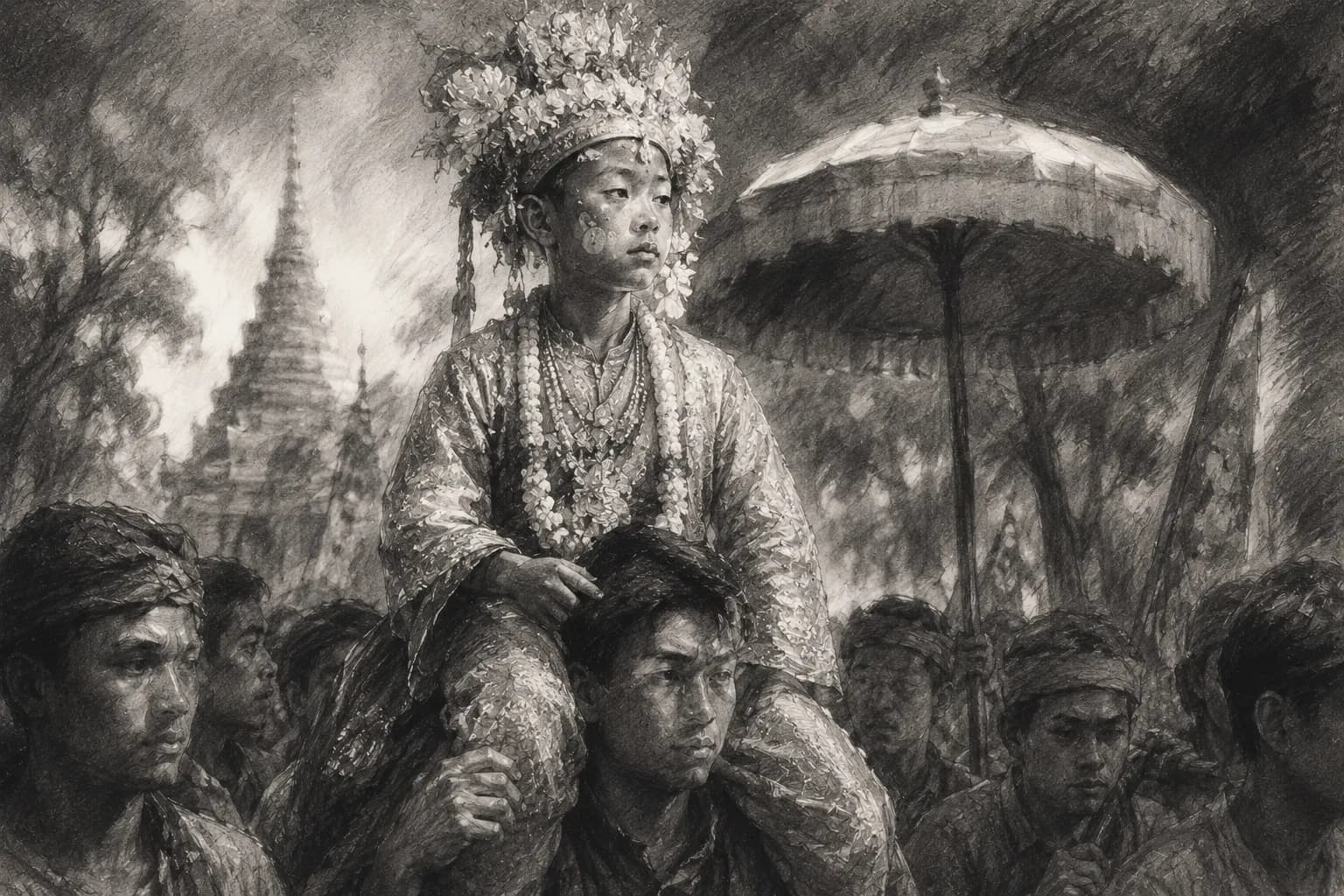
The boy looks as if he has stepped out of an old painting — face made up, a flower crown on his head, dressed in gold-threaded clothes, yet his eyes still those of a child. He does not walk himself, but is carried on a grown man's shoulders, swaying gently in the procession, gongs and drums and umbrella-holding kin before and behind. The sun is fierce, the umbrella's shadow shifting over his face; now and then he glances down at the crowd on the ground, then is drawn back by the gongs.
This is the novice ordination festival of the Tai Yai (Shan), the grandest family event in the Mae Hong Son region of northern Thailand. Poy means festival, sang means novice monk, and long comes from "king" — together, dressing a boy as a prince to be sent into monkhood. Legend says it echoes the Buddha's status as a prince before he renounced the world: before letting go of everything, let him first have possessed it once, completely. So for these few days, this child of an ordinary family is the little prince the whole village holds in its palms.
The family sends him to the temple in the most solemn way possible, as if to say: you are going to do something very important. The grown man carrying him — perhaps a father, perhaps an uncle — steadies him all the way, his own head streaming with sweat, yet not a word said. Each time the procession halts, relatives come up to straighten the boy's hem, wipe his sweat, a carefulness as if preparing for a thing that will never come again.
Gongs, umbrellas and gold-threaded cloth blaze dazzling in the fierce sun, the air a mix of dust, sweat and incense. Carried all day, the boy's makeup has smudged a little, his look turning slowly from the early freshness to something tired, a little vacant. Watching him, one recalls those moments in one's own life that were "not yet fully understood, yet known to be important" — that half-understanding everyone has been through.
The procession passes street after street, the gongs never ceasing. People at the roadside stop what they are doing to look up, some pressing their palms together towards the boy. In that moment one understands: he is carried so high not only to be seen well, but so that the whole village may see — this child, today, is going to do a thing that even grown-ups revere.
The procession ends, the makeup will come off, the finery will be changed for monk's robes, and the boy will live in the temple a while. Standing at the roadside watching him carried away — I think you too will suddenly grasp that this revelry is in fact a tender farewell: a goodbye to some part of childhood. And the whole village setting down its work to walk this stretch with him is so that he will remember he was once carried, solemnly, on someone's shoulders, sent off for part of the way.
Essay