Essay
Carry a tower across the whole town, then give it to the sea
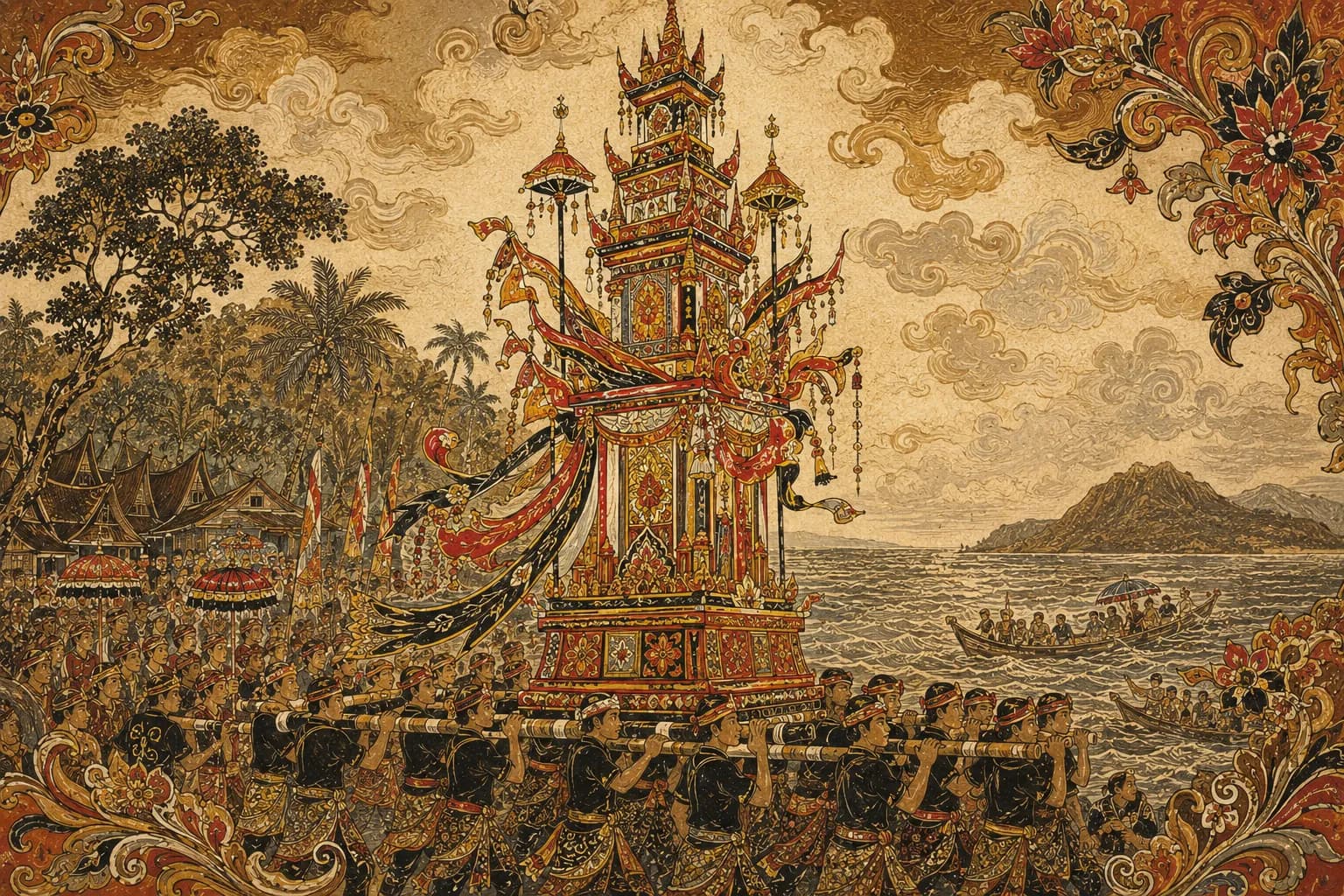
The Tabuik stands taller than a two-storey house, its tower-shaped body of paper and bamboo brilliantly coloured, borne on the shoulders of a great crowd, moving slowly through the streets of Pariaman. The drums do not stop all day, beat after beat striking the chest; the whole town walks behind it, and you too are pushed and pressed into this procession with no beginning and no visible end.
The Tabuik commemorates Husayn, a descendant of the Prophet, martyred in a battle at Karbala. This custom was brought to the West Sumatran coast long ago by Shia soldiers from India, held over the first ten days of Muharram in the Islamic calendar. Beneath that ornate tower a mythical beast called buraq is borne — the steed that, in legend, carried the martyr's soul aloft. In other words, this whole tower is a sorrow a thousand years old, made into a shape one can see.
The more ornate it is, the more it shows how heavy this memory weighs. A young man bearing the tower steps down with his face streaming sweat, and at once another pair of hands takes his place, never for a moment letting the tower stop. The bearers change batch by batch, the drummers' hands gone red, yet the rhythm never misses a beat — one can tell they are not performing, but carrying, on behalf of the whole town, a thing of great importance.
The sun is fierce, the sea wind mixed with drumbeats, the smell of sweat and incense. The tower advances swaying above the crowd's heads, the beast's wings trembling faintly with each step, as if truly about to fly. Following along a long while, one is carried by that ordered, heavy rhythm, no longer able to tell whether one is watching a rite, or has already become part of it.
The sea draws nearer, the drumming beats more urgently, the sound of the waves slowly surfacing from beneath the drums. The tower's shadow falls on the beach dyed red by the setting sun, stretched long; the bearers' steps are heavy, each one pressing into the wet soft sand, leaving footprint after footprint soon smoothed away by the sea.
At dusk, the procession reaches the shore, the drumming at its fiercest, and the Tabuik, borne a whole day, is eased slowly into the sea. I stood on the beach watching it break apart and sink in the waves, the whole town fallen quiet — and I think you too will understand, in that moment, that all this day's splendour and clamour was for the sake of reaching this instant: to hand back, gently, to the sea, a mourning carried a whole day, and a whole year.
Essay